Uncategorized

Disciplining Martina: Heretics and the Church of Trans Normativity

Two main things turned up in my timeline this morning. One was the fall-out of Rachel McKinnon’s egregious and unconcealed bullying of Martina Navratilova, and the other was a Call For Papers from Brighton University that Kathleen tweeted here.

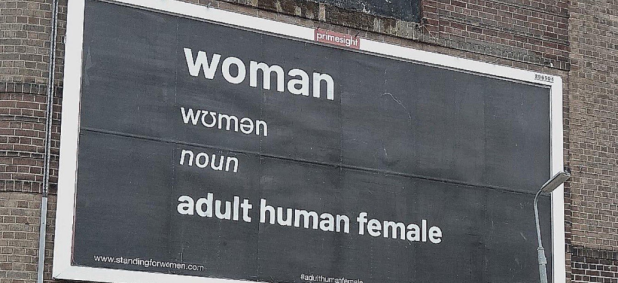
gayness

I was already planning on doing this post on Martina when the CFP popped up – because Rachel’s behaviour last night was a pretty copper-bottomed rendition of what trans activist coercion looks like, and I thought it was worth taking a look at it blow by blow. The academic CFP might, at first glance, seem a little tangential to the issue of trans inclusion in sports, but it refracted with Rachel’s behaviour in an interesting way, so, happy or unhappy accident, this is what you get guys…

gayness 2

The CFP sketches out the familiar claim that ‘queerness’ is ‘inclusive’ and ‘fluid’ while ‘gayness’ or ‘homosexuality’ is ‘exclusive’ and ‘oppressive,’ a dichotomy that rests on the never-fully-interrogated assumption that ‘inclusion’ is an unequivocal ‘good,’ while ‘exclusion’ is an unequivocal ‘evil.’ The parallel here to the issue of trans inclusion in sports is evident – this is precisely the moral logic that makes McKinnon come over all God’s avenging angel to one of the greatest sportswomen – and lesbian icons – of all time. And it’s exactly the logic, to draw the examples closer, which also underpins Rachel’s consistent indictment of lesbians for asserting their same-sex ‘exclusiveness.’ But what strikes me as particularly interesting about the refraction of these two moments with each other, is that the CFP belies a critical contradiction. While the discourse of ‘exclusive’ homosexuality is ‘normative’ (in queer-theory speak this is synonymous with ‘disciplinary’ and ‘oppressive’ – i.e. ‘bad’), queer perspectives, they admit, have now assumed a ‘hegemonic status.’

FART

Quite how the people writing this thought they could parse ‘bad normativity’ from ‘good hegemony’ is anyone’s guess – if ‘normative’ or ‘hegemonic’ discourses are ‘disciplinary’ or ‘bad’ by virtue of being hegemonic, then there is no reason why ‘queer’ discourses should get a free pass. (There is a paradox in the centre of queer thought here – at the point at which queer theory becomes a form of academic normativity, it is no longer, by its own definitions, queer). Indeed, what I want to suggest here, is that Rachel’s behaviour to Martina is exactly a demonstration of the way in which the moral logic of queer ‘inclusivity’ has now become a hegemonic, punitive, and profoundly disciplinary discourse. As we have all been noting over the last months, trans and radical queer activism is animated by a deeply authoritarian and coercive political impulse which leads it to behave like the bastard child of Stalinism and the Medieval Catholic Church. It has produced a generation of aesthetically and discursively identikit activists who are utterly in thrall to their own moral righteousness, the categorical ‘evil’ of anyone who questions their sacred axioms, and their divine inquisitorial right to school and punish heretics. That is, the very fact that a mediocre philosopher and mediocre cyclist considers themselves in a position to discipline someone as widely and rightfully respected as Martina Navratilova for heresy, tells us everything we need to know about which discourse is dominant here, the hegemonic normativity of ‘queer’ inclusivity, and the fact that there is pretty much nothing ‘anti-disciplinary,’ ‘diverse,’ ‘fluid,’ ‘open,’ or strictly speaking, ‘queer,’ about trans activism. ‘In Queer Times’ we find ourselves. Indeed.

(more…)

Ontological totalitarianism by numbers

1984 header-01

  1. Human beings have a right to freedom of conscience and belief.
  2. Human beings have a right to their own perceptions.
  3. Humans beings have a right to speak in a manner which expresses their own conscience, belief and perceptions – providing that speech is not an incitement to violence against another person (see 14).
  4. The only pronouns one can prescribe to oneself, ethically, are ‘I’ and ‘me.’
  5. Third person pronouns are granted to you by another person.
  6. Pronouns function as a ‘recognition procedure’ in order to instruct someone else how they are to recognise someone, often in the absence of, or in contradiction to, observable cues.
  7. Asking someone to use certain pronouns is a request that they perceive or recognise you in a certain way.
  8. Prescribing pronouns is a diktat that another person perceives or recognises you in a certain way.
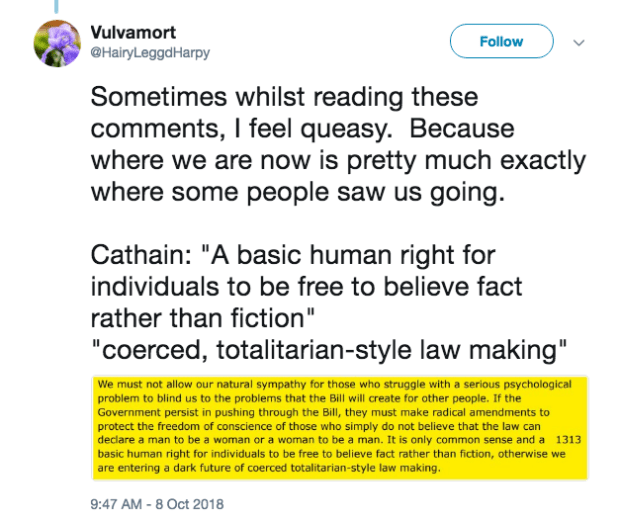
  9. Prescribing pronouns and enforcing that prescription is an act of coercion which violates people’s freedom of conscience. This is ontological totalitarianism.
  10. Resisting coercion is not bullying.
  11. Ontological totalitarianism may well be bullying.
  12. Recognition must be freely given if it is to meaningfully function as validation.
  13. Coerced recognition is both a violation of people’s freedom of conscience and is functionally worthless as validation.
  14. Resisting coerced recognition is not an act of violence – literal or otherwise – nor an incitement to violence.
  15. Trans people who are visibly gender non-conforming are subject to violence as a result of the policing of patriarchal gender norms.
  16. Feminists do not police patriarchal gender norms.
  17. Violence directed at people who violate patriarchal gender norms is an artefact of patriarchy, not an artefact of feminism.
  18. Many feminists believe that sex and gender are analytically distinct, and do not believe that the performance or identification of a person’s gender changes their sex.
  19. This is a matter of our perception of reality and a matter of political conviction. It is not a pretext.
  20. Blaming feminists for patriarchal violence against gender non-conforming and trans identified people is empirically baseless political strategy which serves as an instrument of coercion.
  21. People refusing to validate your identity may be painful.
  22. Something being painful is not conceptually identical to it being a moral harm, structural violence, or an act of oppression.
  23. Not getting our needs met is sometimes painful.
  24. Sometimes our needs don’t get met because other people also have needs, beliefs, and interests.
  25. Thinking you must always have you needs met and refusing to understand why other people may not meet your needs, is narcissistic entitlement.
  26. Narcissistic entitlement is the refusal to recognise the needs and interests of other people.
  27. Narcissistic entitlement is the opposite of mutual recognition.
  28. Mutual recognition is the condition of possibility of justice.
  29. Ontological totalitarianism is a political manifestation of narcissistic entitlement.
  30. Ontological totalitarianism is antithetical to the conditions of possibility of justice.

On Patronage

So, sorry to disappoint, this isn’t a new piece. There’s plenty plugging up the pipeline, but I’ve been catching my breath this last week…

Anyway, following a conversation with some other women on twitter this morning, and various thinkings about how to sustain myself while I continue to do the work I’m doing, I’ve decided to set up a Patreon. If you’d like to support my writing, my battling on the twits, or any of the future projects I have in mind (which I point in the general direction of on the page over there), I’d be extremely grateful.

My page is here.

downloads_wordmark_white_on_coral@2x

‘Burble burble intersex burble social construct burble burble trans women are women!’ Sally Hines on Woman’s Hour

So, as promised, here is an annotated transcript of yesterday’s feminist death match between Sally Hines, Professor of Sociology and Gender Identities at the University of Leeds, and our very own Kathleen Stock, Professor of Philosophy at the University of Sussex, very ably adjudicated by Jane Garvey.

I’ve done kind of what I do when I annotate most texts. Sarcasm, interrogation, incredulity, and analysis….welcome to my marginalia…

We all know how it went, but, enjoy the re-run…. 🙂

—————————————————–

JG: What are sex and gender and what explains the current argument around them? *Introduces Kathleen and Sally*

JG: Okay Sally, in simple terms, I’m starting this one with you, what are sex and gender?

SH: So, sex, I would argue, is a very complex mix of chromosomes, hormones, and genitals…

Shall we talk about gametes or reproductive function, Sally? No, best not eh?

So, we are talking about biological factors, but we’re not talking about anything at all which is straightforward…

It’s COMPLICATED peoples!

So, we’re talking about a complex mix of factors which especially in the West have often been seen in a binary framework…

JG: Hang on, sorry, *slight incredulity* binary framework?

SH: So, sex is believed to divide people into two categories of male and female.

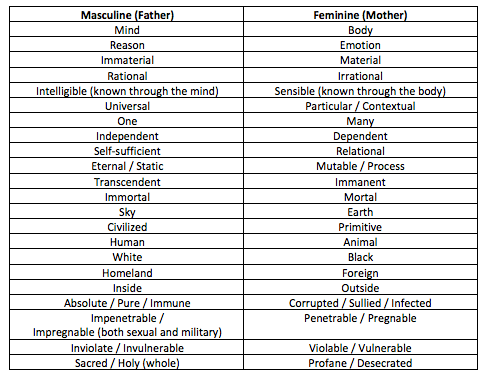
Sally Hines, Professor of Sociology and Gender Identities – THAT IS NOT A FUCKING BINARY. I have sneaking suspicion I am going to spend the best part of the next five years screaming ‘That is not a binary’ at clever-stupid people. A binary is a conceptual hierarchy which is formed by taking a term with a dominant positive value and creating a subordinate value by negating the privileged qualities of the dominant term. Masculine/Feminine is a binary. In fact, it is the ur-binary, to the extent that ALL of the binary pairs which structure Western thought (mind/body, reason/emotion, thought/sensation, universal/particular, one/many etc.) are gendered, and without exception, the ‘positive’ pole of the binary is masculine. Male and female is not a binary, it is a natural difference. The problem arises because Western thought is so thoroughly gendered that it seems people are incapable of thinking the difference ‘male/female’ without thinking it’s cultural hierarchization, or, to return us to the point we keep making – our opponents don’t seem to be able to think sex without gender. (We might think here of another natural difference, say ‘light/dark,’ which is thoroughly saturated with hierarchical value. But let us all agree, despite the fact that this pairing has always been given within a system of binary value, we can all recognise that there is such a thing as ‘light’ and ‘dark,’ and that they exist outside of that system of value, as a natural difference). The fact that binary hierarchies are an axiomatic feature of Western thought is largely where this batshit idea that ‘male’ and ‘female’ are Western constructions is getting its traction from, I think. There are human societies in which the relation between pairs has been thought in a more horizontal and interpenetrating way that in the West – the Taoist image of the Yin/Yang would be an instance of that. But we should, however, note, that cultural systems that have been less hierarchical in their thinking of pairs have still thought those pairs on the basis of the ur-pairing ‘male principle/female principle,’ because the sexual difference between males and females is universally given, not culturally various, and is the fundamental structural distinction of all human society, evah. So please, for the love of the goddess, stop saying that Westerners or ‘colonialism’ invented male and female people. It’s ahistorical Western myopism, unfathomably stupid, and racist as fuck.

JG: Go on

SH: Okay, so, and gender, um, is the way in which a society understands or experiences these sex differences…

Hold onto that thought Sally. You can do it!

Again in the West, these have largely been understood until quite recent times in terms of a binary framework…

Hurrah, she said something correct. Well, except gender still is…again, not thinking the difference…

….so, male and female

DOH! THAT’S SEX DOOFUS. IT WAS GOING SO WELL FOR A MOMENT THERE.

JG: And these understanding are…less well understood, or more widely challenged, how would you define it?

SH: I think that when it comes to sex many scientists are arguing, um, have indeed argued, but but, more so are arguing…that that the binary framework…

Liking the stammering here, could it be because you’re about to talk total crap?

…the simple reading of male and female, is quite a simplistic and very reductive way of understanding a very *complex* procedure

It’s COMPLICATED people! Repeat to fade.

I wonder Sally, if it’s so complicated, how you might explain, how all human societies, for whom we have cultural records, seem to have been able to make this distinction, mmmm?

Um, similarly…

No, NOT similarly

The way gender has been understood in contemporary society has broadened out, and young people especially, are experiencing and understanding their gender as more diverse than a binary male female [DOH] framework allows for…

It’s like the 70s and 80s never happened.

Also, can you STOP with this constant appeal to the ‘young people’ to leverage your baseless idea that this crap must somehow be revolutionary and anti-status quo. Firstly, as suggested above, it’s ahistorical. These kids did not invent gender fucking. It’s been going on in cycles throughout history. Second, it ends up descending very quickly into patriarchal ageism, and is being deployed in concert with a thoroughgoing trashing of the legacy of second wave feminism, which is anything but revolutionary, and relies on the age-old fracturing of genealogy between younger and older women. Thirdly, these kids have been brainwashed Sally, and you are participating in that brainwashing.

JG: *no nonsense voice* When a baby is born, the first thing that happens…anyone who’s had a baby will know this…the first thing that happens, is…obviously you ascertain that it’s alright, and then, you find out, it’s biological sex.

SH: Yup

You sound a little aggrieved there Sally, or maybe I’m imagining it?

I mean, I think, using the term ‘assigned female or male at birth’ okay, rather than ‘male or female at birth’ is a really useful way…

You seem to be confusing ‘useful’ with ‘obfuscating for ideological purposes’ there Sally.

…of looking at the ways in which sex can be understood as something social…so what’s that’s doing then, is arguing, is kind of pointing to the ways in which someone, um, usually a doctor, in this instance, is making a decision, they’re making a presumption, about what sex, um, that baby is, um, and as we’ve seen, um, with intersex, that’s clearly not always the case.

This is a GREAT illustration of what work the intersex issue is doing here, and exactly why they have appropriated the ‘assigned’ linguistic structure. Because it is only in the very few instances that sex is not readily observable that this batshit idea that sex is not simply ‘observed’ but is in some sense ‘decided’ or ‘constructed,’ seems able to gain ANY traction.

JG: *exasperated exhale* Okay, I think a lot of people will take issue, including, I suspect, Kathleen, so, off you go Kathleen, tell us.

KS: Well, I agree, there is, we are increasingly good at understanding er, intersex variation, so, disorders of sexual development, um, and a very very small number, a subset of people with those disorders, are atypical chromosomally, or sometimes, for a very small number, of particular disorders, namely AIS [Androgen Insensitivity Syndrome] and CAH [Congenital Adrenal Hyperplasia], you might get an XY male with a feminized genitalia, or you might get an XX female with a virilised genitalia, so, that’s not the 1.7% of people we are always being told are intersex…

For an excellent breakdown of Fausto-Sterling’s highly dubious 1.7% statistic, see this thread by @mrkhtake2.

JG: It’s tiny

KS: It’s a very very very small number, like, one in twenty thousand I think for CAH, and and, but I think it’s the wrong way to think of it that a doctor looks at a child, a neonate, and say, ‘okay, I’m going to assign a sex.’ What they do is they do genetic testing and blood testing and they work out which variety of disorder this child has, and then there’s a standard, um, y’know, for the vast majority of intersex children there’s an absolutely standard route to recording male or female sex…

JG: But as you say, this isn’t a common problem this, it happens, we know it does…

KS: But it’s also, sometimes, in the rhetoric of ‘sex is a spectrum,’ um, and the assigning of sex, as if it’s a social decision on the part of the doctor, it’s to gloss over the medical procedures, that are pretty well understood now, which result in predicable outcomes for whether this child is going to be counted as male or female.

*Pom poms* This is an EXCELLENT point, and one it’s worth underlining. The whole rhetoric of ‘assigning’ depends on a historic set of procedures for dealing with intersex children, which, as we know, were coercive, invasive, and traumatizing. My understanding from listening to the intersex advocates is, as Kathleen points to here, that these subjective and coercive determinations are no longer clinical practice, and that, far from developments in science showing us that ‘sex is a spectrum,’ increased scientific understanding has allowed us to more accurately determine the sex of children who are born with some degree of ambiguity in their sexed phenotype. It should also be noted, that the very existence of ambiguity in a tiny number of instances, and the fact that they occasion clinical procedures, is also evidence of the fact that in the vast vast majority of cases, no such ambiguity exists, and in such cases, the phrase ‘assigned sex/gender at birth’ is meaningless ideological garbage.

JG: Sally

SH: Okay, okay, yeah, I mean, um *awkward laugh* neither I nor Kathleen, um, are scientists…

Well don’t call on scientific ideas to buttress your ideology then lady.

…there are many scientists however that are pointing to the simplistic understanding of sex,

No, there isn’t. The majority of scientists and medical professionals are having no truck with this nonsense. You have a few ideologically motivated people in the sciences that are invested in troubling the male/female difference, and you endlessly regurgitate and appeal to this, for political reasons, against the preponderant weight of scientific thinking. It’s been said before and it will be said again – you are the climate change deniers of the left.

…um, in the way that that Kathleen’s just talked about…

You’re confused there champ. You said something vague and sweeping while constantly appealing to the term ‘complexity.’ Kathleen said something precise and detailed, and in the process, handed you your ass. And now you’re scrabbling to find it. Understand this: Your vague use of the word ‘simplistic’ carries as much logical force as your vague use of the word ‘complex.’ You don’t get to win an argument by arrogating complexity to yourself and simplicity to your opponents. ‘Show not tell’ Professor Hines.

…okay, and this has also been long recognised in many non-Western countries, um, who have understood that people are often not simply male of female…

TWO-SPIRIT KLAXON. Misrepresentative, appropriative, racist bullshit. HOW THE FUCK HAS THE UNIVERSITY GIVEN PEOPLE WITH TUMBLRISED-BRAINS CHAIRS??????? (Neoliberalism, customer service, ‘impact,’ student satisfaction burble burble)

…and just to say that it doesn’t kind of affect very many people, or it’s a minority problem, or disorder, um, I think is kind of, that’s ignoring the way that lots of young people now are experiencing their lives and their sense of gender, um, as something which is non-binary, which is neither male nor female…

JG: Okay, I can see that you’re struggling with that Kathleen, very briefly if you can.

KS: Well, we’ve moved there, Sally’s moved there, from talking about a medical issue to a social issue, and whether young people feel non-binary or not, that’s got absolutely nothing to do with intersex, those two things are completely distinct.

Well, QUITE. But hey Sally, look on the bright side, you have very usefully exhibited what is at stake in the attempt to undermine the existence of sexual dimorphism. You are invested in an ideology that wants to define the determination of the being of men and women on the basis of identity, and it follows from that that you must undermine the idea that that being depends on sex. (Can someone rustle me up a Guardian journalist or two to come and mansplain to me about how nobody is trying to undermine human sexual dimorphism?) To do that, you must try to unsettle the difference between male and female, and – accompanied by Judith Butler and stoopid notions of social construction that seem to think that because concepts are social constructions everything they name is a simple construction as well – the instrumentalization of intersex conditions is the main way you try and go about that (so yeah, it’s not an accident you came out with intersex burble, is it, really?) Ultimately, the aim is to be able to make people believe that male people can be female people (and female people male – although, if that was all this was about, none of this would be happening, because, y’know, sex and power and shit, we’ll get onto that shortly…). And so, you have to insist that the difference between male and female is one that we can move around at whim, according to our own desires. We can’t. And to believe we can is the very opposite of ‘progressive.’ It is a form of absolute idealism which arrogates to humans – and the power of human naming – the ability to bring the whole world into existence. It is, in short, a god-complex. And an age-old patriarchal one at that.

SH: I’m not talking particularly about intersex…

KS: Well you were originally

Indeed.

SH: But I used it as an example of how sex itself can be diverse…

And as we’ve demonstrated, it doesn’t do what you want it to do. So, Stop. Appropriating. Intersex. People. Already.

JG: I appreciate that you both feel very strongly about this, I worry, somewhat, on behalf of our audience, that we’re getting up a cul-de-sac, that very few people will actually travel down in their real lives. What we do know is that the lives of women, on the whole, can be rather challenging Sally, and sometimes more restricted, and frankly, women can often feel more vulnerable, than their born male counterparts, that is simple fact, isn’t it?

SH: *pause* It depends who you are including in the category of woman, okay?

OKAY!!!!!!

So, there you’re saying, are you saying that trans women are not women? Um, yeah, women, cis women, okay…

OKAY!!!!!

JG: Cis women, a lot of people don’t know what that means, what do you mean by that?

SH: Okay, so I’ll explain, so so, women who are assigned female at birth…? Okay?

OKAY!!! Love the rising intonation here. Yeah Sally…Jane, Kathleen, and the assembled women of the nation all think you’re talking shit…

Um, women who haven’t transitioned, okay? Yeah? Absolutely, have a lot of difficulties in society, but arguing for trans rights, and arguing that trans women are women, doesn’t take away, from recognising that we live in a patriarchal sexist society…

It doesn’t take anything away from that recognition, even though I am apparently unable to appear on the most important womens’ programme in the UK and straightforwardly affirm without hedging, introducing trans women, and calling women by a prefix that they have repeatedly and clearly rejected, that women are oppressed as women.

Also while we’re here, let’s note that for people who proclaim to be all about smashing binaries, you have yourselves created a new binary – the cis/trans binary. The cis/trans binary, unlike the female/male difference, is, actually, an axiomatic binary. It is axiomatic in that the category ‘cis’ is formed entirely by inversion from the category ‘trans.’ Thus, while trans people have a gender identity that ‘doesn’t match’ their sex, we have one that ‘matches.’ Trans ideology therefore imposes a gender identity on non-trans people, despite the fact that we keep telling them we don’t know what it means, have no experience of one, and reject it on theoretical and political grounds. And the nature of this attribution gives the lie to the claim about the hierarchy of power at work in the ‘cis/trans’ binary. Ostensibly, the cis/trans binary names the power cis people have over trans people, and it works in that sense to flip the hierarchy of oppression between male and female people, posit female people as the oppressors of trans women, and hence invalidate women’s political claims and resistances (it is this mechanism which allows the trans rights movement to analogise women with white supremacists, and to claim our exclusions are of the same type as segregationists). However, binaries always work by the ‘inferior’ term being formed by negation of the privileged term, and by the social group identified with the privileged term possessing the power of naming and constructing the binary. That trans rights has successfully created a binary which imposes a name on the ‘other’ term against their wishes, in a manner which they expressly consider to be a misrepresentation, and which functions to give social capital to the group associated with one term and to delegitimise the social group associated with the other term, tells us all we need to know about how power is actually operating in this instance…Or, to cut a long story short, people with penises get to name and define people without penises. AGAIN.

So anyway yes, you were telling us about how cis women are oppressed but not really…. Or maybe we should give the mic to Kathleen instead?

KS: Well, I’m very happy to recognise that we live in a patriarchal sexist society…

THAT’S how you do it.

…I think we do, and since we do, I think we need to retain categories and subcategories that do important explanatory work, and one of those is ‘women,’ ‘natal females,’ you can call them cis if you like, but, if cis is taken to mean ‘happy with the socially imposed gender stereotypes that are put on them as soon as they’re born,’ then most women do not feel cis, if you mean some really strong feeling of being a woman, then most women do not feel like that, they don’t, they just are, they don’t feel…It’s really really difficult in these discussion to find some commonality that all trans women for instance, and all natal women, share, that could explain, how they were both simultaneously members of the same group… and, the even more radical claim that’s being made by you Sally, that there’s no underlying differences, between those two groups in terms of social treatment. And it’s my view that being female, um, being socially, um, perceived as a woman, imposes a significant causal predictor on you, to be the subject of all sorts of discrimination, we see this in the sexual violence statistics, we see this in the pay-gap…it’s not a gender pay-gap, it’s a sex pay-gap, it’s to do with reproduction, which is something that women bear…

SH: I fundamentally disagree

Of course you do. And this is the absolute screaming core of the problem. Because you are committed to an ideology that means you cannot recognise that there is any difference between trans women and women, and therefore, you cannot recognise that female people are oppressed qua female people – that is, on the basis of their sex. And that makes you, simply, an un-feminist. Because my dear Professor, like everything, being a feminist is not actually a matter of identification, it’s a matter of practice.

JG: Why do you disagree Sally?

SH: I think I think trans women um, also, um, if not sometimes more so suffer harassment, suffer violence, suffer sexual disadvantage, um, in society…

1. But not because they are female.

2. Stop it with your baseless hierarchy of suffering lady. You think playing people’s wounds off against each other is going to get us somewhere good, you dangerous idiot???

….and for me regulating the category of woman, arguing around, y’know, who can, and who can’t belong, um, to that category, based on an idea of gendered authenticity, or realness, is not the way forward…

Male people commit violence against gender non-conforming people, and especially against perceived femininity in male people, because of the structure of patriarchal gender. It has not now, and had never, had anything to do with feminist women believing that mammals are sexually dimorphic and that women are oppressed on the basis of their sex. Stop blaming women for men’s violence and stop blaming feminists for patriarchal gender.

Also, this thing about the hierarchy of real and fake. Again, this is a conflation of a cultural hierarchy with a given difference. Yes, there are instances in which we have distributed value by constructing some things as more authentic than other things, and then there is the fact that there just exists a difference between real things and imitations. Fake fur is not somehow real fur, and diamanté is not somehow real diamond, because you have decided to believe that all judgements about ‘realness’ and ‘fakeness’ are only cultural hierarchies of value. I actually agree with you that it is unhelpful, and unnecessarily derogatory, to frame the difference between trans women and women as that between ‘realness’ and ‘fakeness’ or ‘imitation.’ However, it is in your interests to insist that the difference must be framed in that way, and then to use that to claim that anyone insisting on a difference is being derogatory.  I would simply say that there are female people, that there are male people who identify as women, that male people are not female people, and that sex is politically important. These are not attributions of value. They are just empirical facts.

Lastly, you have absolutely no empirical proof that this derogatory system of value is the reason for male people’s violence against trans women. Why should we accept that this violence is created by the belief that trans women are ‘fake’ women (which then allows you to apparently blame feminists for male violence), rather than the belief that these are male people who are performing femininity in a way that violates the first rule of patriarchal masculinity? (which would mean that gender abolitionist feminism would actually ameliorate violence against trans women, a fact which could, and should, be the basis of our solidarity)

JG: Yeah, again, we’ve got to make this conversation relevant to everybody, and I’m particularly aware that many of our listeners have had tough lives for one reason or another, they may well be even now still facilitating the lives of others, possibly they’ve done nothing but that for the last fifty years, and, it’s hardly surprising that many of those women feel that their hard won rights are somewhat vulnerable at the moment Sally to the progress of some other, for example, trans women. What do you say to that?

Top marks to JG for all of this, especially for bringing the issue of the sexed distribution of care work into the conversation here. I am reminded of this quote from a feature on Martine Rothblatt, in which it was made pretty obvious that the woman with the vagina was still the one responsible for looking after everyone’s material (and probably emotional) needs.

SH: I completely disagree…

That female people do the majority of unpaid domestic and emotional labour in the world? That’s not a matter of opinion Professor.

I think, y’know, gender politics and progressive politics can’t, y’know, be kind of based on a hierarchy of difference in this way…

How many times do we need to tell you this??? Differences are not hierarchies. They’re differences. If you refuse to recognise difference you refuse to give recognition to the particularly of individual lives, and the way those lives are shaped by membership of social groups, and the needs and political interests of people who belong to those social groups. That is not progress and it is not justice. It is erasure and domination.

…y’know, and we’ve seen this before, it’s very very dangerous, we’ve seen this before in feminism, in relation to the position of Black women, and in relation to the position of working class women, y’know, I think we absolutely as feminists have got to move away from a politics which is based around perceptions of realness, and that white, cis women such as myself, such as Kathleen, have got to give up some privilege here…

Let’s unpack some intersectionality burble then shall we Sally? First, the imputation that Black women and working-class women are a subset of women whose womanhood is ‘less real’ that white women’s womanhood is bullshit, and politically motivated and offensive bullshit. There have always been and remain tensions within feminism along race and class lines, and there probably will always be, because these intersections are massively important political and social differences that cut though the body of women. We will, I hope, always continue to wrestle with these issues, to give them space, and to endeavour to work with them in order to best articulate our shared interests as women, and to allow for the expression of our differences. As I have said before, it is not easy, and it shouldn’t be. None of this translates into an idea that Black women or working-class women are somehow not women, and Crenshaw never intended intersectionality to be used to fracture the class of female people in order to include male people. The fact that Black females are female does not mean that male people are female, and you really need to stop and have a long hard look at yourself and what the fuck you’re saying. Frankly, this makes my blood boil. And I know from listening to many Black women that they find it enraging – both because their womanhood is being undermined, and they’re being used as a political prop in an argument, and maybe even more so, because it’s being done with a veneer of woke anti-racism, while being fucking racist, and the women doing it won’t listen to them when they call it out.

Secondly, can you imagine anything more white and middle class and privileged than thinking you can avoid sex-based oppression by identifying out of it? What kind of life have you lived, that you respond to a well-grounded observation about the distribution of care-work (let alone femicide, or poverty, or lack of education, or FGM, or forced marriage, or sexual slavery, or any other of the number of sex-based violences that disproportionately affect women with less economic and racial power, or from cultures with more rigid patriarchal practices than our own), and turn around, and say that you are fighting for the interests of working class and women of colour by denying the analysis of the basis of their exploitation????? This whole towering pile of bullshit is precisely an artefact of privilege. Walk into any Gender Studies class in the country if you have any doubts. Over to Kathleen…

KS: I am exactly here to fight on behalf of the interests of Black and working-class female women, it is them that bear the disproportionate brunt of inequality in our society, and if we lose the ability to name those people as such, and to talk about the causal factors that lead to their predicament, then we won’t be able to fight for them, so it’s precisely dangerous, the kind of rhetoric that’s coming out of the new gender identity doctrine…

JG: Sally, can I just, I mean, if it were a level playing field, why do we not hear as much from trans men as we do from trans women?

BOOM. Answer that question while avoiding granting recognition to the political importance of sex if you will Sally?

SH: *Sharp intake of breath through nose* I think, trans men are often ignored, okay

OKAY!!!!!???

JG: Well, we don’t ignore them…

I’m a little bit in love with JG by this point…

Well anyway, carry on…

SH: I think that trans men are not seen to be a threat…

Correct. Because they’re not. Because they’re female.

…by some sections of feminism…um, in the way that trans women are…y’know, there has been lots of critique of trans men from second wave feminists, such as Sheila Jeffreys, who argued that trans men are simply trying to get, y’know, they’re women who are trying to get male privilege, so, y’know, trans men have been critiqued and attacked by some sections of feminism, but, in the culture that we’re living in at the moment, in contemporary times, um, it is trans women, who’ve become the bodies of fear, um, for some feminists…

Yup. Because this whole situation has been created by feminists and has absolutely nothing to do with the politics of the trans rights movement, the nature of their demands, their attempts to erase women, or their persistent efforts to enforce their agenda by using the immemorial tactics of coercive control. And none of this has anything to do with the fact that many of the people directing this movement are late transitioning people who were born and socialised as males, or that we live in a culture that grants power to those people, precisely because they are male. None of this would be happening were it not being driven by male interests in changing the definition of woman in order to colonise it. Trans men do not have the social power to redefine and enforce that redefinition on men – as is amply demonstrated by the fact that the language around the naming of men remains implacably untouched by this whole situation.  This is precisely a demonstration of the very fact that it purports to deny – that is, the existence of sex, and its political importance. THAT’s the answer you were looking for Sally.

As for the ‘bodies of fear.’ Male people are a statistical danger to women. That is not a construction, and it is not a projection you can nattily analogize to xenophobia. It not an ungrounded fear of the ‘foreign,’ through which women create an illusory sense of safety or security by projecting their fears onto the ‘other’ outside. Nothing about the analysis of male violence serves to make us feel safe, so you can put your garbled post-structuralist misappropriation away right now. Rather, our fear of male people is based on the fact that our lives are blighted and controlled by the violence, and the threat of violence, visited on us by male people, and, as any feminist knows, that violence is not merely accidental or natural. It is structural, inculcated, and used as a form of social control. And if you want to dispute that, you can, any minute now, start arguing like an MRA, and we’ll take what remnants are left of your feminist card back lickity-split.

JG: Okay, last word to you Kathleen, if you can be brief, I’d be grateful…

KS: Well, trans women are not inherently dangerous, and no one on my side of the debate thinks that, but we recognise that they are male, biologically, and socialised as males, and that makes it more likely, statistically, that some of them will be violence, sexually violent, towards females…

SH: I completely disagree, and would say..

KS: Well I know you do but…the stats bear it out, so…let’s go to the evidence…

SH: Trans women are women

You have argument and I have MANTRAS! Take that!

KS: Well, you can keep saying that…

Indeed. And they will, and it won’t become any truer, or have any bearing on the statistics.

But the evidence…I’m not even talking about that, I’m talking about how this is practically, um… realized in society, and we have to make decisions about how to order spaces, how to…

SH: But who makes those decisions…?

Good question Sally! You are supporting a political movement that is insisting that those decisions be made on the basis of an unscientific, ideological mantra, and only in the interests of trans women, and that anyone who questions that, or who claims that this is a rights conflict, or that women should be a stakeholder in the making of those decision, is a bigot. So yeah, who does get to make those decisions? Shall we move on to talking about that?

KS: And to keep repeating ‘trans women are women’ won’t get us anywhere.

BOOM.

prince mike

TOTAL DEMOLITION: That wins you a Prince, Professor Stock xx

The Annals of the TERF-Wars

So, yesterday this turned up in my feed, which struck me as something of an, um, mispresentation… and somehow, I ended up writing my own version of how this whole thing went down…

owl


Prologue: A long time ago in a galaxy far, far away…

Transsexual women: We just want some basic human rights.

Women: Okay.

Transsexual women: We have this condition called gender dysphoria and it’s really painful and we need to transition to live as the other sex because it’s the treatment for the dysphoria.

Women: Yeah, that sounds tough. Okay, if that’s what you need to do.

Transsexual women: We’d like you to treat us as women.

Most women: Um, okay. Sure, we can do that if that helps.


Prequel: A long time ago in a lesbian bar that no longer exists

Lesbians: We don’t have to treat you as women for sexual purposes, do we?

Many transsexual women: No, that’s cool

Nascent trans activists: Well, actually, if you don’t want to fuck us then it invalidates our womanhood and that is misgendering and it’s a human rights abuse and you should want to fuck us.

Lesbians: It’s a human rights abuse if we don’t want to fuck you? What the fuck?

Nascent trans activists: Yes, you should want to fuck us.

Lesbians: Even if you still have dicks?

Nascent trans activists: Even if we still have dicks.

Lesbians: Um yeah, sorry, we don’t do dicks. We’re LESBIANS.

Nascent trans activists: You are vagina fetishists with unconscious bias and are gatekeeping your vaginas. We are women and our dicks are women’s dicks. If you don’t want to fuck us, you’re bigots.

Lesbians: We’re not bigots, it’s just you’re male, and we fuck female people.

Nascent trans activists: LITERAL VIOLENCE. WE ARE WOMEN. YOU SHOULD WANT TO FUCK US.

Lesbians: Um yeah, we’re not really feeling that right now to be honest.

Nascent trans activists: TERF TERF TERF TERF TERF.

Lesbians: HEY PEOPLE! These people are pressuring our sexual boundaries because they say they’re women but the way they’re pressuring us doesn’t make us feel like they’re women…in fact, it makes us feel like they’re men and we don’t fuck men. We’re lesbians, we don’t fuck men. That’s the reason we did all the marching, so that was okay right? RIGHT????

(Nascent trans activists: TERF TERF TERF TERF TERF)

Lesbians: HEY PEOPLE!!! Could we get some fucking help here?

Rest of the LGB community and world: Did someone say something?


Episode 1: The First War Begins. Scene 1: Cyberspace – probably around 2013

Trans activists: So hey, when we said we’d like you to treat us like women that wasn’t right, because actually, we ARE women and we demand that you treat us exactly like women because we are women and that you to stop violently excluding us from all your women things.

Women: Um, we thought you were male people who had to transition to help with your dysphoria?

Trans activists: No, that is out-dated and pathologizing. Women are women because they have a gender identity which makes them women.

Women: Um, we thought we were woman because we’re female?

Trans activists: No, you are women because you have magic womanish essence that makes you women. We have the same magic womanish essence as you, it’s just that ours got stuck in the wrong body.

Feminists: That sounds kind of sexist. Can you tell us what this woman-essence is, and how it gets stuck in the wrong body, because that sounds like a weird metaphys…..

Trans activists: It’s SCIENCE.

Feminists: Science says there’s ‘magic woman essence’??? Are you sure? Because feminism would…

Trans activists: Shut up bigots.

Feminists: Sorry? What?

Trans activists: You are our oppressors, you don’t get to speak. When you speak you oppress us, and it literally kills us.

Feminists: WHAT?

Trans activists: You are cis women, cis people are our oppressors.

Feminists: We’re what?

Trans activists: It’s your new name, it comes from Latin, and means you have a magic gender essence that matches your body, and because your magic gender essence matches your body you are privileged…

Feminists: Hang on a minute, women are oppressed because they are women, we’re not really sure that’s a privilege…

Trans activists: YOU ARE PRIVILEGED BECAUSE YOUR GENDER IDENTITY MATCHES YOUR BODY. Nobody knows the pain of being trapped in the wrong body. It is the greatest pain of all the pains that has ever happened to all of human kind, and everyone who does not know this pain is privileged and is therefore our oppressor.

Feminists: Um, were not really sure we’re oppressing you, we don’t have much social power to oppress you, we’d just like to ask you some questions about this gender identity thing….

Trans activists: ARE YOU DEBATING OUR RIGHT TO EXIST???

Feminists: What? No, we just wanted to ask you…

Trans activists: YOU ARE DEBATING OUR RIGHT TO EXIST. THIS IS LITERAL VIOLENCE.

Feminists: No no no hold on, we’re just trying to ask you a question…

Trans activists: WE WILL NOT DEBATE OUR RIGHT TO EXIST. YOU ARE TRYING TO EXTERMINATE US. YOU ARE JUST LIKE GENOCIDAL RACISTS

Feminists: What??? We’re like genocidal what??? This is fucking crazy. Can we just try and calm down and talk about this?

Trans activists: NO. There is NO DEBATE. Debating is literal violence and makes us unsafe. Repeat after us – Trans women are women. Trans women are women because they have woman essence, just like cis women. You’re not women because of your bodies. Bodies have nothing to do with being a woman.

Feminists: Okay, this is sounding nuts now, because we really think our bodies have quite a lot to do with our being woman.

Trans activists: Bio-essentialism!

Feminists: What? Essentialism is bad we agree, but that means thinking people with certain kinds of bodies have to…

Trans activists: No, essentialism is thinking male and female people exist.

Feminists: But male and female people DO exist.

Trans activist: FUCK YOU TERF. DIE IN A FIRE.

Feminists: Woah.

Trans activists: How many fucking times do we need to tell you this cis-scum? Your body has nothing to do with your being a woman. There is no such thing as female biology.

Feminists: WHAT THE FUCK????

Trans activists: The gender binary was created by white heteropatriarchal colonialism.

Feminists: WHAT THE ACTUAL FUCK???? WHAT DOES THAT EVEN MEAN?? WHICH ‘COLONIALISM’????

American trans activists who don’t know the rest of the world exists: Colonialism colonialism duh.

Feminists: How the hell is the colonization of North America responsible for the creation of male and female people? And while we’re here that sounds kinda racist…

Trans activists: Two-spirit people burble burble sex is a spectrum burble clown fish burble burble intersex people burble burble some women don’t have ovaries burble social construct burble Judith Butler

(Academics with cool-girl syndrome and assorted edgelords and wokebros: JUDITH BUTLER!!!!)

Trans activists: ….burble burble, there is no such thing as female biology and women are women because they have magic gender essence and therefore some women have penises!

Feminists: Okay, this is batshit. We REALLY need to talk about this.

Trans activists: WE WILL NOT DEBATE OUR RIGHT TO EXIST.


Episode 1: The First War Continues. Scene 2: Cyberspace – around 2013-14

*Enter Intersectional Feminists from top, bottom and side of screen….*

Intersectional feminists: THEY WILL NOT DEBATE THEIR RIGHT TO EXIST YOU FUCKING BIGOTS.

Feminists: Hang on, we thought you were feminists. We thought you cared about female people.

Intersectional feminists: Female people are so last century. Only White Feminists care about female people.

Feminists: White what?

Intersectional feminists: All the feminists before us were white middle-class women and they only cared about what white middle-class women care about and they were only interested in getting good jobs for white middle-class women and they didn’t care about Black women and were dried up whorephobic prudes who didn’t realize sex work was liberating and mostly they just wanted to kill trans people.

Feminists: That sounds like some mad-ass caricature.

Intersectional feminists: You would say that, you oppressive old crones. You’re just saying that to maintain your power.

Feminists: No we’re not, we don’t have much power. We’re saying it because it sounds like bullshit. *Starts trying to explain all the things second wave feminism did to help women*

Intersectional feminists: We’re not listening to you, you oppressive bitches. We’ve hidden all your books in the library to protect young minds from them. You are whorephobes and transphobes and racists. We are intersectional. Only we have learned from the Tumblr-oracle how all the different oppressions have different points on a scale that add up to who is the most oppressed and you are white (so are we mostly but we’re pointing at you because somehow that means something, maybe because we have asymmetric hair-cuts and our profile pics give great side-eye) and you are women and that means that you are the least oppressed and that means that your feminism is shit and that means that you have to centre all these other people in your feminism and if you refuse it’s because you’re the oppressors and the most oppressed people are trans women and they must be the centre of feminism from now on.

Feminists: You want us to centre male born people in our feminism?

Intersectional feminists: THAT’S RIGHT BITCHES. And there is no such thing as ‘male-born people.’ That is cissexism and is literal violence. You need to educate yourselves. We don’t have the spoons.

Feminists: Um yeah, we know quite a lot about the history and practice of feminism and we’ve thought quite hard about it and I think we’re going to carry on centring female people if you don’t mind.

Intersectional feminists: OPPRESSORS

Feminists: Female people are oppressed and our political movement…

Intersectional feminists: SWERF AND TERF. SWERF AND TERF. SWERF AND TERF.

(Ps – Would you like to try this sourdough bread I made with yeast from my vagina?)

Feminists: Okay. This is getting REALLY fucked up now.

Intersectional feminists: Run away and cry your ‘White Feminism TM’ tears you dried up old witches. And don’t fucking kink-shame us or we’ll shank you.

Feminists: Um, this feminism seems not very…

Intersectional feminists with new blue hair: BIG DICK ENERGY.

*TERF-blocker descends*


Episode 1: The End of the First War. Scene 3: Cyberspace and public sphere, 2014-5

Feminists: *Educate themselves* *Become increasingly horrified* *Start writing articles nobody fucking reads*

HEY PEOPLE! This shit is mental. There are these people saying being female has nothing to do with being a woman, and that they’re women because they have magic gender essence, and this sounds pretty sexist, and they also say that sex doesn’t exist and given we’ve always thought that that’s the reason we’re oppressed we’re pretty worried this is a bad idea for women and feminism, and now these other people who say they’re feminists are telling us we have to centre people who are not female in our feminism or we’re the oppressors and are going on and on about how we shouldn’t say anything because we’re whorephobic bigots and it’s kind of nuts and people are bullying lesbians to have sex with people with penises and they’re encouraging young people to take hormones that we don’t seem to understand the effects of and we think this is all sketchy as fuck to be honest. What the hell is going on?

Trans activists and intersectional feminists: That woman talking over there is making people unsafe because she is an evil bigot and trans people are the most vulnerable people in the world and she is the oppressor and she is oppressing us by speaking and if she speaks then it is literal violence and it will make people hurt us and we will also hurt ourselves and so you have to stop her speaking and if you don’t stop her speaking then you are also an evil bigot and we are going to tell everyone what evil fucking bigots you are and you wouldn’t want that now so you better stop her speaking right fucking now.

Civic institution: Um, what now?

Trans activists: *Pickets* *Inundates with letters and emails and phone calls* *Goes on twitter and gets a massive pile of people to bombard institution*

Civic institution’s PR people: This makes us look bad.

Civic institution: Okay, we won’t let the bigot speak. I mean, she’s just a feminist, right?

Trans activists: Hurray we are safe! Ding dong the witch is dead!

Feminists: What the fuck? HEY PEOPLE! I was just trying to say something because I think there are some questions here and I think we should really talk about it. I’m not sure people are women just because they have magic woman essence and I think there might be some not good consequences of thinking this.

Trans activists and civic institutions: SHUT UP BIGOTS.

Misogynist child with column in major left-wing newspaper: SHUT UP BIGOTS. YOU’RE THE KIND OF PEOPLE WHO THOUGHT GAY PEOPLE WERE ALL KIDDY FIDDLERS.

Feminists: Um, lots of us are lesbians actually and the rest of us were totally behind gay rights, like, we’ve always been allies, what the hell are you going on about?

Misogynist child with column in major left-wing newspaper: *Blocks all the women objecting* WRONG SIDE OF HISTORY BITCHES.

Woke bros and assorted leftie-misogynists: *Jumping up and down with excitement* WRONG SIDE OF HISTORY UPPITY BITCHES.

Trans activists and civic institutions and leftie newspapers:  REPEAT AFTER US – Trans women are women. Because trans women are women then trans women should be given all the social resources given to other women and if you don’t accept this then you are exclusionary bigots and we’re going to make damn sure everyone knows what terrible terrible people you are and how you shouldn’t be allowed to live or work or speak or write in public. Have you fucking got that???

Feminists: You’re intimidating and silencing us.

Trans activists and leftie newspapers:  No, we’re not. You trigger people by existing and asking questions and having the wrong opinions. You need to shut the fuck up so that everyone is safe. RIGHT NOW.


Episode 2: Between the Wars. Scene 1: Public sphere, 2015-2017

Feminists: We’re feeling pretty demoralized here…

Trans activists: EXCELLENT. You just sit over there and keep your little lady-mouths shut.

*Organise some more* *Take over Stonewall and all the LGBT+ organizations* *Start sending people into school and institutions to explain that people have magic gender essence which sometimes gets trapped in the wrong body* *Bully, harass and no platform any woman who speaks up*

Hey, government. We’ve got this great idea. You know how people think you’re a bunch of assholes who has been driving the economy into the ground and lining rich people’s pockets while you let vulnerable people starve, we’ve got just the ticket for you.

Government: *Ears prick up* Tell us more.

Trans activists: Yeah, all you have to do is change this piece of legislation so we can get our sex changed more easily. The current legislation is really burdensome, and we’re really vulnerable, and it would really help us out, and would totally make you look like you care about marginalized people while costing you fuck all.

Government: Well, that does sound like a boon. Is there a catch?

Trans activists: No, not one. It’s just streamlining an administrative process really.

Government: Okay, come and tell us all about it. Is there anyone else we need to talk to?

Trans activists: No. It doesn’t have any effect on anyone, it’s just paperwork really. JUST MAKE SURE YOU DON’T TALK TO THOSE UPPITY WOMEN OVER THER THEY’RE ALL EVIL BIGOTS WHO WANT TO KILL US.

Government: Oh yes, they do sound like terrible people, how awful for you.

Trans activists: Yes, they’re really horrific. And while we’re at it, you might want to think about removing their rights to single-sex spaces from the Equalities Act because it discriminates against us.

Government: Interesting. Okay, when can you come in?


Episode 2: Between the Wars. Scene 2: The Take Over Continues, Labour Party, 2016-17

The left of the left: Austerity sucks! Neoliberalism sucks! WE. WANT. SOCIAL. DEMOCRACY. NOW.

Some of the feminists: Yeah, we want that too.

Other of the feminists: We think these people might be wankers.

Some of the feminists: Noted. Let’s see what they say….

Momentum: WE. WANT. SOCIAL. DEMOCRACY. NOW.

The new leader of the Labour Party: WE. WANT. SOCIAL. DEMOCRACY. NOW.

Some of the feminists: Okay, great….

Momentum: ANYONE WHO DOESN’T WANT SOCIAL DEMOCRACY NOW IS A CAPITALIST SHILL.

Some of the feminists: Well, we get what you’re saying, but….

Momentum: CAPITALIST SHILL. CAPITALIST SHILL. FUCK THE COLLABORATING CENTRIST BIGOTS…

Some of the feminists: This seems strangely fam….

Momentum: ….AND WHILE WE’RE AT IT, TRANS WOMEN ARE WOMEN!

The new leader of the Labour Party: TRANS WOMEN *ARE* WOMEN.

Momentum: TRANS WOMEN ARE WOMEN TRANS WOMEN ARE WOMEN AND ANYONE WHO QUESTIONS IS A BIGOT.

Some of the feminists: Ohhhhhhhhh FUCK…..

Other of the feminists: We told you they were wankers.

Misogynist child with column in major left-wing newspaper: Trans women are women and the only people who disagree with me are those centrist collaborating shills over there…

Some of the feminists: Well THAT’S bullshit.

Momentum, Labour leadership, misogynist child and chorus of brocialists: TRANS WOMEN ARE WOMEN. TRANS WOMEN ARE WOMEN. CAPITALIST BIGOT SHILLS BIGOT SHILLS BURN THEM BURN THEM…

Bastardi: Fully automated luxury……

Some of the feminists: Yup. Wankers.

Other of the feminists: Told you.

Labour Party women: So, about this trans women are women thing, we just have a few….

Momentum, misogynist child and chorus of brocialists: SHUT UP YOU FUCKING TERF BIGOTS.

Labour Party women: TERF-what?

Momentum, misogynist child and chorus of brocialists: You are ‘Trans Exclusionary Radical Feminists.’ That means you’re evil and witches and that people can punch you and it’s not violence against women because you’re witches.

Labour Party women: Um, we’re not sure we’re radical feminists, or that we’re excluding anyone, but we definitely don’t think anyone should be punching women and we just wanted to….

Momentum, misogynist child and chorus of brocialists: ZIP IT.

Labour Party women: *in a huddle in the wings, whispering quietly* What the fuck????

HEY PEOPLE! We’re Labour members and this a democratic political party and we think we should….

Momentum, misogynist child and chorus of brocialists: WE TOLD YOU TO ZIP IT.

Labour Party women: But…

Momentum, misogynist child and chorus of brocialists: TSZUP!!!!! *makes zipping motion*

Labour Party women: Well, we think we want to talk about this so we’re going to go over here and….

Momentum, misogynist child and chorus of brocialists: GREAT. FUCK OFF. WE DON’T NEED SHILLS LIKE YOU IN THE REVOLUTION ANYWAY…

Feminists: This is a fucking clusterfuck.

Momentum: We have this awesome young trans woman who we think would make an awesome Women’s Officer because she’s awesome and trans women are awesome and trans women are women and there is no difference in any of their life experience which means they might not understand women’s political interests and anyone who suggests that is a fucking bigot.

General public: Huh?

Young trans women’s officer with variable coloured hair: Hi, I’m Petal, and I’m very petally, and that means I know all about women and their petals and I can represent all the political interests of petals and when I get a womb-transplant I will be even more petally, and if you don’t like my petals…

Labour Party women: No no, your petals are fine, it’s just that you’re very young, and for most of the time you were alive you were….

Petal: I WAS WHAT? I have *always* been a woman…

Labour Party women: Yeah, we’re just not quite sure about that bit….

Petal: FUCK YOU, YOU TRANSPHOBIC BIGOTS.

Labour Party women: Um, we thought you were supposed to be representing us, and actually, it doesn’t seem like you’re really doing very much….

Petal: FUCK OFF TERFS.

General public: What the hell is going on…?

Feminists: Yeah, we kind of…..

Momentum, trans activists, misogynist child and chorus of brocialists: WE THOUGHT WE TOLD YOU WITCHES TO BE QUIET ALREADY.


Episode 3: The Second War Begins. Scene 1 – Somewhere in Whitehall, 2018

Government: We think we’re going to change the law. Just a little administrative clear up to make life less burdensome for the trans population who, as we know, are terribly vulnerable.

Feminists: You’re going to do what??? Why didn’t you ask us about this?

Government: Yes well, the trans people said it didn’t affect you.

Feminists: THEY SAID WHAT??? Hang on a motherfucking minute.


Episode 3:  The Witches Strike Back. Scene 2: Cyberspace and public sphere, 2018

Trans activists: REPEAT AFTER US: Trans women are women. Trans women should not be excluded from any spaces women have access to. Anyone who questions that is an exclusionary genocidal racist who is in league with the far right. And by the way, you’re not women anymore, you’re cis women, and we want you to stop talking about your bodies, and we’re going to change all the words in all the literature that has anything to do with you so that everyone understands that being female is not necessary to being a woman, and from now on you are ‘mentruators’ and ‘cervix havers’ and ‘pregnant people.’ Got that?

Women: WOAH. You fucking what? We’re cis-what? And we’re not women anymore, we’re menstruators. We don’t think we like this.

Trans activists: It’s inclusive.

Women: Well, it sounds dehumanising as all hell to us.

Trans activists: Shut up cis people, you are the oppressors. These are the new words for you.

Women: Don’t we get to decide which words we use for ourselves?

Trans activists: No, you are the oppressors, if you do not accept these new words you are oppressing us.

Women: We’re oppressing you by wanting to be called women??? What the hell is….

Trans activists: BIGOTS! These are your new words. You are cis women, and we are trans women. We are both just different types of women, except we’re more oppressed than you so you have to do what we say. Look, there’s nothing you can do about it, the government already agrees with us, see?

Women: The government already agrees with you? What?

Trans activists: Yes. REPEAT AFTER US: Trans women are women. The government believes this and is going to change the law so that we can be legally recognised as female if we sign a piece of paper that says we have magic woman essence…

Women: What??? This can’t be right. Surely someone would have said something about this? Where are the feminists? Feminists, is this right?

Feminists: U-huh. We were trying to….

Women: What are the implications of this???

Feminists: *montage of charts and essays* *three weeks later*

Women: Fuck this shit. We need to do something.

Feminists: YES. WE. DO.

Feminists and radicalized women and intersex people and transsexuals and concerned parents and gay men who are realizing something’s up and some straight male allies: EVERYONE HOLD HANDS AND PUUUUUUUUUUULLLLLLLLLLLL.

The press: The women seem to be making a shit-ton of noise about something? Why are there stickers of cocks everywhere??? What on earth is going on?

Trans activists and the left-wing press: NOTHING, THEY’RE BIGOTS.

Most of the press: Oh, okay.

A few journalists: *Digging around* What the actual fuck??????

Feminists and allies: EVERYONE KEEP PUUUUUUUUUUULLLLLLLLLLLLING. IT’S MOVING.

Trans activists: BURN THE WITCHES BURN THE WITCHES BURN THE WITCHES.

Feminists: Ha, yeah, we’re not so scared of you and your words now are we? There’s a ton of us here. And people are starting to listen. EVERYONE. C’MON. PUUUUUUUUUUUULLLLLLLLLLLLLLL.

Trans activists: BURN THE WITCHES BURN THE WITCHES BURN THE WITCHES.

Women and allies: PUUUUULLLLLLLLL.

Feminists watching from around the world: Hell yes! PUUUUULLLLLLLLL.

Women and allies: KEEP FUCKING PUUUUUUUUUUULLLLLLLLLLLLING.

Trans activists: BURN THE WITCHES BURN THE WITCHES BURN THE WITCHES.

Government: Lah-lah-lah.

A few journalists: Um actually, we had a little look at this thing, and we think the women might have a point.

Trans activists: NO THEY DON’T THEY’RE WITCHES BURN THEM BURN THEM.

A few journalists: Now, come on, there is a proposed change to law, and this is a democracy, and they have some arguments that seem quite compelling, and there have been some things that have happened recently that seem to suggest that maybe there’s some substance to their concerns, and it seems like we should think this through.

Trans activists: NO DEBATE. BURN THEM BURN THEM.

A few journalists: We’re not sure that’s really helping your case. We think we’re going to start covering this in more depth.

Trans activists: YOU CAN’T LISTEN TO THEM THEY’RE WITCHES. IF YOU DON’T GIVE US WHAT WE WANT WE’LL KILL OURSELVES.

Women and allies: PUUUUUUUUUULLLLLLLLL. IT’S MOVING IT’S MOVING!!!!!!!

Feminists watching from around the world: PUUUUULLLLLLLLL!!!!!!!!

Major left-wing newspaper that has been steadfastly quiet: *ostentatiously clears throat* Um, actually we think the women might have a point.

Women and allies: *BACKFILPS*

Trans activists and allies at home and abroad: OMFG why is the British media so full of evil bigots??????

Women and allies: *Lying in a bundle panting* Whatfuckingever asshats.

<Fin>

On the Being of Female People

So, one of my recent pieces attracted a fairly long piece of critique. I’m not going to respond to the whole thing, but there was a couple of points I thought it might be interesting to get into  – mostly because they touch on stuff I’ve been turning over in general…

History_of_weaving_2048x2048

Criticism the first: I don’t understand how binaries work

“Jones touches on the erasure necessary to binary oppositions, but fails to grasp what it actually means.”

Okay, so… let’s kick things off with the assertion that I don’t really get what ‘erasure’ means with respect to binaries (ho ho, rightbackatcha). I’ve spent about 15 years thinking about it, but… fair enough, if you’re then going to display your infinitely greater understanding….

“Binaries are bad not just because they’re hierarchical, but because they deny everything outside those hierarchical categories.”

This ‘not just’ is a pretty massive tell… because, as we’ll get on to, packed inside it is basically the whole structure by which female people are oppressed/erased as female people…so yeah, no biggie. Evidently, not granting existence to female people isn’t really very important. What is far more important is that binaries don’t represent multiplicity correctly. This point is half right, but the elaboration is kind of scuppered by the fact that my critic doesn’t quite understand how binaries work…

“If the binary insists that everyone is either X or Y, and that X is superior to Y, then insisting that X people and Y people are naturally different but equal might be a slight improvement, but it doesn’t get any closer to dealing a reality where some people might be X in some ways and Y in others, or might indeed be A, B, C, gamma or theta. To “insist on the reality of both parts of a natural difference” – so, saying that some people are European, and others are African, and both are equally good – is still to reproduce the erasures imposed by colonialism. It obviously doesn’t offer much to, say, Asians or indigenous Australians, but even just talking about Africans, to group them together as “the other pole” is still to deny the existence and diversity of pre-colonial-binary identities.”

Okay… so a binary isn’t ‘X or Y.’ As I’ve said, binaries work by being both a) hierarchical and b) by defining the ‘inferior’ term by negation. A binary isn’t constituted as ‘X or Y,’ it’s constituted as ‘X and not-X.’ ‘European’ vs. ‘African’ is not a binary. The racial binary is constructed by white supremacy, and conceptually it functions around the contradiction, ‘white/not-white.’ So, to look at a specific instance, ‘Blackness’ is constituted by the white imagination as an inversion of the privileged qualities of ‘whiteness.’ (Particularly in this case, ‘civilized vs. not-civilized (primitive)’, ‘rational (mind) vs. not-rational (emotional, sensual, embodied), ‘human vs. not-human (animal).’

This whole thing gets into a right mess here, however, because the gender binary and racial binaries don’t map exactly onto each other. The gender binary is laid on top of the biological difference between male and female people. The racial binary isn’t actually one thing, because the ‘white/not-white’-structure functions in reality as a conceptual relation between ‘whiteness’ and various different ‘types’ of ‘non-whiteness.’ Therefore, you can’t make a straight analogy here.[1] The structure of the gender binary is harmful because it is hierarchical, and because it ties sexed bodies to certain types of acceptable social behaviours, but if we follow through on the analogy used here, what we get is the claim that the ‘real’ harm of the gender binary is that it erases the other ‘natural’ differences it’s laid on top of – i.e. that it erases the people who are neither male or female, which would be, actually, nobody.[2]

Gender Binary

Racial Binary/ies

Conceptual structure Masculine/Not-masculine White/Not-white
Biological difference Male/Not-male (i.e. female) White/Everyone who is not white (with specific contextual significations depending on different types of ‘not-white’)

Racial binaries are also built on far more culturally determined differences because race, unlike sex, is: a) much more spectrum-like b) capable of hybridization and c) what counts as ‘not-white’ is not only a matter of biological features, e.g. Irish, Italians and Latinos of predominantly ‘white’ heritage in the US.

What this confused analogy serves to do then, is to side-step the fact that the principle harm of the gender binary is that it functions to define female people as the negative image of male people, and removes female people’s cultural power to define themselves for themselves. (Which is not to say that there would be a singular definition of what ‘being female’ means to female people, were they to be able to get on with the job of creating their own signification (which we do do, in community with other women, to some degree, although, as we’ll see, nobody seems to much notice…)).

Moreover, to say that female people having the cultural power to define themselves would only be a “slight improvement” in the situation is a frickin joke. Male people ceasing to define female people in their own terms and through their own projections would be the end of patriarchy. What my critic fails to grasp here then, is that the harm of ‘not representing diversity’ in the negatively defined group is itself a product of the mechanism of projective definition – because defining something by inversion necessarily flattens the perception of variation into the uniformity of ‘not-x.’ It is, therefore, ultimately a product of the narcissism of patriarchal masculinity, and it is this structure of patriarchal inversion which was then repeated in the construction of the racial binary (or racial binaries). If you solve the problem of narcissistic patriarchal inversion, you then also solve the problem of the flattening of diversity in general. However, and this is key, my claim would be that the greatest challenge to that narcissistic structure comes from the irreducibility of sexual difference. The issue with ‘multiplicity’ or ‘diversity’ as a simple remedy to patriarchal narcissism is that it very easily collapses into a type of ‘inclusivity’ which tries to include everything inside a new kind of ‘one-ness.’ That is, my wariness about the idea that ‘inclusion’ or ‘diversity’ is a de facto good in all circumstances is very much related to my sense that it is informed by the desire to obviate the much harder work of actually learning how to relate across difference. That is, ‘inclusivity’ is animated by the patriarchal narcissistic impulse to collapse all difference back into sameness (while looking like it’s doing something to undermine it, and actually not).

“Of course, Jones could object that she actually wants “to spend a lot of time thinking through what [colonised people] are”, and that this effort would really mean understanding and respecting the full range and complexity of these identities.”

Woah there. First off, it’s pretty telling that you’re conducting this entire critique using the example of race, rather than sex, because as I’ve suggested, they don’t map exactly onto each other. Secondly, I would never make the statement you have put into my mouth there with your parenthetical sleight of hand. It is not my work to ‘spend a lot of time thinking about what colonised people are.’ Creating signification for themselves is the work of people who have been negatively defined by white power – which they have always been doing pretty spectacularly – and the work of using those significations to challenge dominant definitions is also theirs. This is fucking obvious.

“but if we’re talking about pre/non-colonial cultures, then again we’re back to social categories, not biological differences. And again, in such a case we’d be looking at a range of social identities that don’t fit neatly within a binary, which in turn sounds an awful lot like the dreaded “trans ideology”.

Firstly, as I’ve said, if you understood how binaries work, you’d understand that all of the variations are subsumed by the binary, because the ‘not-x’ covers everything that is not-x. In the case of the ‘not-white’ of the racial binary, that includes a ton of variation (and how it functions specifically depends on the particular context in which it is deployed i.e. the ‘white/not-white’ structure signifies differently when applied to say, white American/African-Americans than it does to white-Americans/Latino Americans. The crucial point, however, is that in both cases, the non-white group is defined by negation of the white group). In the case of the gender-binary it refers to the cultural meanings attached to female people (and the policing of femininity in male people arises from trying to ensure that the characteristics of the ‘inferior’ class don’t manifest in the ‘dominant’ class). And secondly, yes, the definitions of racial categories are more social than sexual difference. That’s also why you’re using that example rather than sexual difference isn’t it? Glad we’ve cleared that up.

Criticism the second: I believe in ‘eternal feminine essence’

“Jones goes on to assert that “It is, in fact, the existence of sexual difference that serves as the basis for resisting the patriarchal binary, because it is the existence of sexual difference which grounds the claim that the female has its own being, outside the definition imposed upon it by patriarchal opposition.”

We can agree that to resist the patriarchal binary, there needs to be something outside it, but for this something to be “the female… being” we’d need a bit more clarity about what that actually is. If it’s just physical difference, then I’m unconvinced that simply stating that some people have wombs is going to do that much to bring down the patriarchy; but if we’re talking about something beyond simple physical difference, claiming that “the female being” is some kind of eternal feminine that exists outside of patriarchal categories, then it seems like Jones has arrived at the conclusion that gender essentialism is actually good now, which sets her drastically at odds with the feminist tradition – when 1970s women’s lib marchers raised slogans like “biology is not woman’s destiny”, should they in fact have been telling the world “actually, biology is women’s destiny, but a slightly different one from what patriarchy says it is”?”

So, this is actually interesting, and it raises some issues we get into rather a lot on our own side. As I’ve said repeatedly, it’s not a matter of simply stating that some humans are of the sex-class capable of bearing young (I’m not going with ‘having wombs’ (or vaginas even – given the LostVaginaSongs hilarity over the nonsense efforts to undermine the existence of female people)). What it is a matter of is asserting the importance of female people producing their own definitions, and their own cultural significations, for themselves. It should be obvious that this isn’t an assertion of ‘eternal feminine essence,’ but it seems it’s really not. Here it is actually instructive to look at the parallels with race. It is evidently the case that ‘Blackness’ is not only a category constructed by whiteness, but is also a culturally meaningful term to Black people, and is imbued with cultural significations coming out of Black culture (and here there’s issues of the fact that there is not only one ‘Black culture,’ but, nonetheless, there are meaningful cultural histories, tropes, practices and narratives there). When one of my fellow Prince scholars writes something critiquing the way white culture elides Prince’s blackness, or commenting on the way Under the Cherry Moon is a self-conscious performance of Prince’s blackness, do I read him as claiming that there is an ‘eternal Black essence’? Yeah no, I don’t. And neither does anyone else. And it’s worth thinking about why that is.

This also touches on the question we ourselves keep getting snagged up in. I have repeatedly claimed that I consider ‘female’ to be a biological category, and that I consider ‘woman’ to be a biological/cultural composite. When I make that claim, many feminists I am allied with understand the ‘cultural’ dimension to refer only to the definition of ‘woman’ given by patriarchal culture – that is, to ‘patriarchal femininity’ or ‘gender’ in the feminist sense. And, to return to the origins of our own tradition in Beauvoir, it is indeed the case that that constitutes by far the largest part of what ‘woman’ currently means, and that this mechanism of the cultural definition of female people by male people, is, as I’ve suggested above, the central cultural operation of patriarchy. The place where I depart from a straight-forward gender-abolitionist account is that I think we are cultural creatures, and I don’t think the abolition of patriarchal gender would consist of there being no cultural meaning attached to sexed-bodies. I think rather it would consist of a culture in which the meaning of female bodies – and the forms of social life occupied by female bodies – was defined by female people.[3]

That this possibility is not even heard, by both allies and critics, is evidence, I think, of the absolute dominance of masculine signification. We recognise that an assertion of ‘Blackness’ by a Black artist isn’t an assertion of ‘eternal Black essence’ because we recognise that there is Black culture. That we don’t recognise the same thing with respect to a claim about female people signifying the ‘being of female people’ is evidence of nothing so much as the absence of women’s culture, or rather, the extent to which there is relatively little recognition, even among ourselves, of what that culture is, and/or would be. We have had half a century in which feminist women have variously worked at creating, and curating, and narrating that culture. We have poems and plays and songs and the recovered histories of our foremothers. Some of us name ourselves witches, and place ourselves deliberately in a somewhat mythic maternal genealogy with the women who were burned before us. And yet, when I talk about the ‘being of female people’ outside the terms of masculine definition, when I suggest that the whole structure would be utterly upended if female people had the power of signifying their own being, it apparently signifies nothing.

And that, if we think hard about it, tells us pretty much the whole tale.

——————————

[1] You could, at a push, argue that the ‘real’ problem with the racial binary is that it flattens the differences between various types of ‘non-whiteness’ – although given that these binaries actually function in specific contexts, I’d still be a little skeptical. What this would amount to then is something like the claim that the ‘real’ problem with the negative construction of ‘Blackness’ is that is doesn’t include Latino/as, and I suspect African-Americans might have some thoughts about that.

[2] I imagine what this person is actually driving at is that the gender binary is bad because it erases the multiplicity of possible gender presentations. They don’t quite get at this using the analogy they’re using for the reasons I’ve suggested…race is a much more social category than sex, the meaning of racial groups isn’t laid on top of such clear biological differences, and there is a multiplicity of those groups in a way there is not in the case of sexual difference. Anyway, to be charitable, let’s just scrap the analogy and take the claim as, ‘the gender binary is bad not only because it is a hierarchy but because it erases multiple gender presentations.’ In that case I’m going to agree. I’m not going to agree with the more-or-less explicit attempt to hand-wave away the hierarchical aspect as something to not get too worked up about…and to a certain extent, contained in this is a kernel of the whole conflict – people who conceive their oppression to reside in the social policing of their gender presentation vs. people who conceive their oppression to stem from gender as a social hierarchy imposed on sexed bodies. However, yes, the gender binary is also bad because of the way it ties certain social and gender performances to sexed bodies. Our claim is that the way to deal with that is not to try and abolish the recognition of sexual difference, but to abolish the system of patriarchal gender. It is further my claim that the way you do that is by allowing female people to signify their being for themselves. And the reason for this is because, as I’ve been suggesting, patriarchal gender functions by a process of inverting masculine narcissism, which cannot allow female people to signify for themselves. That is, if we had what Irigaray calls ‘a culture of sexual difference,’ that would, necessarily, be something completely other to a system of patriarchal gender – a system in which there would be far more fluidity in the types of acceptable expression, because there would be no binary.

[3] It seems that the confusion arises here because what I mean by ‘the being of female people’ is both the recognition that female people exist, and the recognition that female people get to define and elaborate what ‘being female’ means (and to be clear, it would hopefully turn out that what ‘being female’ means would involve rejecting a great deal of what it currently means, and resignifying most of what is left). That is, ‘the being of female people’ is both biological and cultural, because anything we might be able to say about what it means, is, necessarily, cultural. Because it is cultural, that doesn’t mean, however, that just anyone gets to define it. The importance of sexual difference, and the recognition of sexual difference, is precisely about the culture that would be created if female people were given the power of their own signification (which would be, effectively, the biological/cultural composite of ‘woman’ being defined by female people). While the meaning of ‘Blackness’ is cultural, there is still a massive political and cultural difference between ‘Blackness’ defined by white people in binary opposition to whiteness, and ‘Blackness’ as defined by Black people in their own terms. (And note here, when I use ‘Blackness’ here as a binary other of ‘whiteness’ I am referring to a specific application of the binary which refers to the relationship between African-American and white American culture).


A Short(ish) Note on Academic Totalitarianism

I’ve been thinking a lot about totalitarianism of late. About what I’ve started to call the ‘ontological totalitarianism’ of compelling us to believe in legal fictions, and about how that then manifests in the totalitarian political strategies of the trans rights movement. Another aspect of this general tendency is also playing out in academic discourse – and in some ways, because I’m a (mostly itinerant) academic, this is the one that really gets me where it hurts. The civic function of the academy, and especially the function of my own discipline, is to hang around in the public square and ask a ton of annoying, difficult and impertinent questions. We are supposed to be a Socratic pain the ass. We are supposed to hold public and political discourse to account. And we are supposed to stand there pulling gratuitously rude faces when people with political power spout incoherent twaddle, or when they make legislative proposals that have potentially awful consequences.

Which is all to say, I spend a lot of time on the phone at the moment ranting with my best friend about how the academy is flagrantly failing in its civic duty – at a time when the humanities are particularly under threat – and about how a whole load of people should frankly be ashamed of themselves.

One of the things that is going on here, of course, is that people are scared. All of us who have spoken out on this have received numerous messages from colleagues, offering support and agreement, and explaining at length why they feel unable to say anything. (In the case of junior academics with insecure employment, let me just say, I hear you, and neoliberal precarity is totally part of the story here). Along with many others I put my name on a letter this week protesting the harassment of academics who want to speak about, write about, or do any kind of research about the multiple theoretical and practical issues thrown up by the present dominance of transgender ideology. But that’s not what I want to talk about here. What I want to talk about here is the many many academics who are not just keeping their heads down and hoping this thought-policing will come to a blessed end soon. Rather, I want to talk about the ones who are actively supporting and enforcing it.

When I first encountered trans ideology about six years ago, it never occurred to me in a million years that the academy would just roll over for this pile of cobbled-together, anti-materialist, life-denying, patriarchal, bullying bullshit and ask it to tickle its tummy. The whole thing is a reality distortion cognitive dissonance machine. It’s an exercise in mass gaslighting that relies on a concatenation of double-thinks. And I had supposed, naively it turns out, that the people who are paid to think about things, would, y’know, think. Quite why it has prompted not inquiry, but compliance, is complex. It has, in the first instance, a lot to do with a catastrophically clay-headed application of the analysis of oppression. With the fact that people have just lapped up the cis-trans binary and the claim that women are the ‘oppressors’ of trans people, and that their political interests are, therefore, the interests of the dominant class (yeah, because radical feminists have so much institutional power, don’t they, Professors of Gender Studies?). For those of you still labouring under the illusion that the trans rights movement is simply an emissary of the oppressed, that they have no political power, that they are challenging entrenched interests, or that their agenda represents a significant challenge to the status quo, I give you Exhibit A:

transcorp

International Finance, Multinational Pharmaceuticals and Spy Surveillance Central for the Revolution!

Seriously people, please.

The other major factor in why this ideology has been so easily absorbed by the academy is, however, down to the dominance of what we’ve been talking around over the last few months – the pre-eminence of what we might call a ‘discourse all the way down’ model of reality. I’m not here, intending to ally myself with the Pluckrosean faction and start banging a drum for a simple return to objectivism (because yeah, that always collapses into a ‘view from nowhere’ which is also, often, ‘a view from privilege’). However, as I’ve been trying to map out, the problem, as always, is with the way these two positions are structured in an opposition that excludes the space between. Reality is made between subjects and objects, between the subjective and the objective, between culture and nature, between ideas and material limits. It is as wrong-headed to think it’s all a matter of objective facts as it is to think it’s all a matter of discourse. But the present problem plaguing the humanities is the extreme seduction that has been performed by the idea of ‘discourse all the way down,’ and the way this is implicated in the enthusiastic adoption of the idea that there is no such thing as male and female bodies, and the further thought that anyone who thinks there is is obviously an oppressive bigot.

The extreme seductive power of this idea – as I allude to in places in this conversation – is that people get really overexcited by the thought that if oppression, and injustice, are simply ‘described into existence,’ then they can, relatively simply, be ‘described out again.’ The foundation of this thought is Foucauldian, and it rests on thinking that there is no ‘natural’ psychophysical reality, or material structures, that underpin and limit discursive possibility. As I point to in this discussion, this leads, in the case of Foucauldian feminist discussions of rape for example, to the absurd, idiotic, and frankly seizure-inducing idea that the only reason why rape is harmful is because feminists have gone around saying it’s harmful, and that if we all just shut up about it the harm would magically disappear in a great big puff of smoke. That is, for Foucault, discourse is not primarily descriptive of any reality, but is, essentially productive of that reality (again, here we find a failure to think the interaction between description and production). And this has had, more or less consciously, a powerful effect on how people think about the function of the academy. Rather than studying and describing social phenomena and producing analysis to critique, challenge and transform the world, the academy becomes only an organ for producing social reality through the production of discourse.

To many, this all has a nice liberatory patina to it. Or rather, it has nice liberatory patina to those people who didn’t, like me, feel a kind of cold ontological shock spread up their spine when they read 1984 and grasped the fundamental danger of constructing consensus reality through duplicity and coercion. To be honest, it pretty much blows my mind that in the middle of post-truth Trumpian tyranny there are still people running around inside universities who haven’t started wondering whether this ‘discourse all the way down’ business is really quite what it’s cracked up to be. And it blows my mind even further that they haven’t started to realize that claims about the limits of materiality – or the ‘2+2=4ness’ of the world – are not always oppressive cultural norms masquerading as nature in the interests of the powerful, but are actually also – sometimes – the material bulwark against the reality distortion that power puts in place.

With respect to trans politics it seems many people are still stuck at thinking that we can remake the world with nothing but our minds. We can bend ourselves into mental pretzels to argue that human sexual dimorphism is a social construct, and we can fantasize that the abolition of sex will yield the abolition of sex-based oppression. Anyone who doesn’t comply with this fantasy, who goes around doggedly insisting that sex, is, in fact, a thing, and that no amount of rhetorical jiggery-pokery and discursive control will actually make it not-a-thing, becomes, then, an emissary of oppression. And this then yields a situation in which we find certain feminist academics vociferously insisting that other feminist academics should be censured – and not even engaged with – for committing the crime of believing sexed bodies to exist, for allegedly ‘weaponising’ such bodies, and for not complying with the demand that consensus reality be refigured around the erasure of those bodies. (We’re feminists, what did you think we’d say when you tried to erase female bodies. I mean. Come the fuck on). That is, what this yields is a form of academic totalitarianism in which many academics completely forget that the university is supposed to serve society by doing discursive interrogation, and commit themselves to making it, instead, a pure instrument of discursive political control.[1]

Which is all to say, great work with the liberation guys.

Well played.

———————————————————–

[1] To be clear, I’m not aligning myself here with the argument that has been coming out of the right for years about the inherent coerciveness of say, critiquing someone for being racist. The role this argument has played in convincing well-meaning left-leaning academics that our concerns about trans ideological totalitarianism are just free-speech arguments covering for a reassertion of power has been considerable. So, I want to say clearly, the difference here is between thinking that social phenomena like structural racism or rape culture are social constructs (which in large part they are), and thinking that sexual dimorphism is a social construct (which is isn’t). It is the case that presenting social phenomena as natural in order to make them appear to be a social inevitability is ideological and politically dubious. It doesn’t follow from that that thinking natural phenomena are natural is politically motivated and ideologically dubious. What is going on with trans ideology is the insistence that something natural be perceived as constructed, and the attempt to socially coerce that perception. That is, there is, between racism and the perception of sexual dimorphism, a meaningful difference. The analogous statement to ‘there are male and female humans’ is ‘there are black people’ (indeed, race is more socially constructed than sex, but nobody is arguing that we will overcome structural racism by pretending, and coercively insisting, that black people don’t exist – and, in fact, most left-leaning people would be horrified by that). So, I am not saying that there is something totalitarian about the attempts by academics to critique and change oppressive structures of power. I am saying there is something totalitarian in attempting to enforce compliance with a belief that something which is manifestly a thing is not, in fact, a thing. That is, this all comes back down to, at base, the point about the ontological totalitarianism of compelling belief and perception with regard to what is, in fact, a legal fiction.


Identity, Sovereignty and Narcissism

Part 1: Identity and Recognition


tom

As many of you know, one of the things I’ve been banging on about of late, is the way the current form of trans rights politics is widely understood to be postmodernism’s (not very red-haired) step-child. As we saw in the piece on Butler, the central idea here is that post-modernism/post-structuralism is a form of ‘linguistic idealism’ that thinks everything is ‘discursively constructed,’ that there is no ‘objective’ reality, and that, therefore, in the final analysis, meaning is just whatever we happen to say it is. This kind of commitment to the infinite possibilities of social construction – and the accompanying belief that social norms are just things we plucked randomly out of our back-pocket – is what is driving the batshit idea that sexual dimorphism is something we just made up one Tuesday, probably sometime shortly before the colonization of North America. It also seems to be implicated in what we might think of as the excess of ‘subjectivism’ going on – the priority currently being placed on individual feeling or experience over consensus reality. And my claim about all of this – and this is my story and I’m sticking to it – is that this ‘discourse all the way down’ version of events is basically a butchered interpretation of deconstruction, and that what trans rights politics is doing, moreover, actually flies in the face of what deconstruction tells us about the world.

identity

The notion of identity, and what we mean by identity, is key to this whole story. And the infinite irony of the way mangled-post-structuralism is currently washing around in the background of this debate is that if I had to sum up the core of deconstruction in one line, I’d say ‘it’s the critique of identity.’ That is, deconstruction properly interpreted is actually a really useful tool for explaining what’s so wrong with trans rights claims that ‘I AM WHAT I SAY I AM,’ and ‘I am the determinant of my identity,’ and, equally, the idea that identity is ‘a simple case of individual rights.’ Because the core deconstructive insight, as I’ve laid out before, is not that nothing means anything, or that things are just what we randomly decide they are, or that everything is simply ‘discursively constituted.’ The key deconstructive insight is that the being of things – that is, their ‘identity’ – is not just something which exists only and exclusively inside those things. It is, rather, something that exists between one thing and other things. That is, the key deconstructive insight is that identity is, in fact, a relation.

The thought that identity is an internal property of an entity is one of the oldest in the philosophical book. I could try and do a whirlwind tour here of Parmenides, and Plato, and Descartes, and the concepts of ‘essence’ and ‘substance’ in philosophical thought, but I’m going to spare us all the agony. Instead, I’m going to give you a diagram of the inside of Plato’s head and one of my favourite Derrida quotes. Like so:plato brain 2

If anyone is interested in the full philosophical argument, the first chapter of my thesis lays it out here (warning, I was trying to get a PhD, so it’s kinda dense). The short version is this: Western thought traditionally thinks the being, or identity, of things in terms of their possession of an internal, singular, simple, coherent, pure, absolute essence. ‘Identity’ derives, etymologically, from the Latin ‘identitatem’, meaning ‘sameness.’ An essence is what makes something the same as itself, and different from other things, and things are what they are because they have an essence, which, in the traditional Platonic account, consists of what is the same among all the things of that type. So, the essence of roses – or the roseness of roses – would consist of all the things that are the same amongst all instances of roses – the smell, the shape, the arrangement of the petals, the texture, etc – and it would be something that inheres, essentially, inside a rose.[1]

roses

This all seems kind of reasonable on the face of it, but it doesn’t take that much thinking for the petals to start coming off. Firstly, we are already, from the very start, dealing with a concept, and the concept of, in this case, ‘roseness’ is manifestly not something that actually exists inside a rose. That is, from the very start, the ‘identity’ of a rose depends on a relation between the rose and the mind that grasps the rose (and note, this doesn’t mean roses don’t exist without minds… but they don’t exist as concepts, and identities are, at least in good part, concepts). Second, the formation of concepts does not involve only the recognition of what is the same inside an entity, but also, what an entity is not. That is, the formation of any concept involves a relation between identity and difference, between what is the same and different inside and what is the same and different outside, in a way that means it’s not clear that ‘identifying’ something involves only understanding what its internal or inherent sameness is. Thirdly, even more broadly, the meaning of entities, and concepts, and words in general, consists of their relation to their context – objects gain meaning thorough their position in a world of other objects, in relation to the social functions they fulfill, and words mean by virtue of the words next to them, and the specific social and emotional contexts in which they’re used. (We can, after all, say ‘fuck off’ in a way that means ‘I love you’ when we do it the right way at the right time). Lastly, and this has a lot to do with our psychic investment in identity as self-sameness (we’ll get to that in the next part) – no entity is entirely self-supporting. The relationality of meaning is also existential. All things arise out of other things, through dependence, and exist in a state of constant interaction that informs and sustains them. Or, to make an awful mess of John Donne for present purposes, ‘no rose is an island.’

So why does this all matter now? It matters now because when Western thought came to think about human subjects, and their identities, it thought them in the same way as it thought the being of objects, and concepts and words. We think ourselves as self-enclosed self-identities. And that matters in this debate, because it’s that idea that leads our friend Tom to think that the being of trans people is simply a matter of individual self-determination. That trans people have an essence that makes them what they are, that they are the only authority on that essence, and that it’s all just a ‘simple’ matter of ‘individual rights’ – an idea which would be just fine and dandy were it not for the fact that rights, like identities, are also, in fact, relations.

Kinesis

That identity necessarily involves relation all becomes painfully, politically obvious in how this whole thing is playing out in practice. Someone can claim that trans people have an absolute right to determine their identity, but were that actually a simple ontological truth, then we wouldn’t be in an endless, fraught spiral about pronouns and misgendering and the world’s recalcitrant refusal to offer up the correct ‘validation.’ Being what you are is not merely a matter of a feeling, or of a ‘feeling of some fundamental essence.’ It’s a matter of being recognised by other human beings as the thing that you think you are.[2] It’s a matter of social relations. And this is why we’re in this whole fucking nightmare mess. Because we have a political movement claiming, on the one hand, that this is just a matter of identity, and it doesn’t affect anyone else, and anyone who thinks otherwise is just a nasty evil bigot, while, at the same time, because identity is all about social relations, they’re throwing a ton of their political weight into trying to control people’s speech, and behaviours, to enforce the validation of those identities.

Pride Soc

The issue about the conflict over spaces, and the conflict about competing rights, is, in some sense, simply an amplification of this fundamental ontological issue. The trans rights movement is committed to claiming that trans people’s access to spaces, and trans people’s rights, has no impact on women’s spaces, or women’s rights, in just the same way as they claim that trans people are the sole and singular arbiters of their own identities, and it doesn’t affect anyone else. Were any of this actually true, this god-awful scrap wouldn’t be happening, because, despite the daily bullshit turned out by the trans rights movement, none of it is happening because a bunch of left-wing feminist women were suddenly afflicted by a plague of inexplicable hatred. The fact that it’s manifestly untrue that this doesn’t affect anyone else – and that, despite quintupling-down, the advocates of the ideology know that it’s untrue – is entirely given by the exhaustive efforts to control the ways people respond to trans people. Indeed, as we saw when we looked at Stonewall’s definition of ‘transphobia,’ it is given, most chillingly, by the effort to proscribe as an act of hatred the refusal – or to be blunt, often just the plain inability – to ‘correctly’ recognise a trans person’s identity.

transphobia

It’s worth underlining here – and this matters with respect to the butchering of post-structuralism – that when I say that identity is a relation, I am not saying that something’s existence is only a matter of what we think it is, or that our concepts about the world arise in some kind of willy-nilly made-up way. What I am saying, as the ever-wise Kinesis points to above, is that concepts, and identities, arise through the interaction between us and the world. In Western thought we make an endless hash of understanding this, because our language has always already separated objects from subjects, and objects from concepts, and we’ve then spent the best part of two and a half millennia frantically trying to work out how to suture them back together. To solve the puzzle we have to start instead from understanding that everything, including ideas, are beings-in-the-world. That everything exists through with-being, or co-existence. A rose is a rose for us both because it is a rose, and because I recognise it as a rose. I recognise it as a rose because it is a rose, and it is a rose because I recognise it as one. It’s being as what it is for us arises in and through itself and its recognition, and the ‘objective’ and ‘subjective’ elements of this interaction cannot be neatly disentangled when we try to explain how we know what something is, because in the interaction through which meaning arises, they are not separate.

pronoun

Most of the time, apart from in philosophy departments, this doesn’t cause great conniptions. We mostly wander around correctly identifying things and getting on with whatever we’re supposed to be getting on with. But when it comes to trans politics it’s causing enormous conniptions. And it’s causing enormous conniptions because the explicit claims of trans rights politics are based on trying to deny the basic interactive being-in-the-world that is identity, and on trying to make the individual the sole and sovereign legislator of what their identity is, while at the same time – and entirely disingenuously – trying to impose rigidly prescribed ‘recognition procedures’ on everyone. As I’ve started to suggest, this is, in fact, the give-away, because the thing about being-in-the-world, and the way it usually works, is that we usually do a pretty bang-up job of identifying things, and no one has to compel us to do it right. The very fact that a political movement has had to initiate such baroque recognition procedures – and that it is attempting to enforce those recognition procedures by classing mistakes as an act of hatred – tells us something very important. And what it tells us is that they can’t just rely on us doing it right. And they can’t rely on us doing it right because, in some meaningful respect, trans-beings-in-the-world are not what they’re telling – indeed demanding – that we think they are.[3]

10- things

This is what I’m talking about when I say that the totalitarianism we see from the trans rights movement – the threats, the slurs, the bullying, the demands for validation, the lists of narcissistic diktats, the inveterate Woke Stasi bullshit policing of people’s Twitter likes and retweets – is all, at a basic ontological level, baked in. If you ground a political movement on the idea that people are actually something that they’re not – or, to be a bit more charitable, you decide, for the first time in history, that the identity of someone does not reside is any observable feature of that someone, but only in some imperceptible internal magic essence – then you will inevitably end up trying to turn that imperceptible essence into a reality by rigidly disciplining other people’s recognition procedures, and disciplining them, moreover, away from what they actually do recognise. Even if this didn’t all cash out into an fuck-off huge rights conflict over access to women’s spaces (which it inevitably does, for exactly the reason of the social recognition such access conveys), the claim that trans rights has no effect on anyone else would still, at this base ontological level, be a MASSIVE fucking lie. No purported civil rights movement has ever tried to mandate, with such coercive force, how people speak, what they can and can’t believe, and what they must pretend to perceive, all in contravention of what they actually do perceive. As Vulvamort discovered when she went back to the Hansard records of the original GRA debate in 2004, the fundamental totalitarianism inherent in prescribing in law that a male person must be recognised as female (or vice versa), was presciently foreseen by lawmakers at the time. In an effort to avoid the issue of same-sex marriage, it was an insight that they chose, pragmatically (or rather, homophobically), to hand-wave-away. And it’s that obviation that has now come back to bite us all – and the very functioning of our democracy – on the ass.

vulvamort

Part 2, in which I discuss the idea of identity and how it relates to notions of sovereignty,  domination, exclusion, and security… coming, erm, shortly(ish)

————————————————–

[1] In the original Platonic account, the story is actually a little more complicated than this. Roses are roses because they possess, or partake, of ‘roseness,’ but the fundamental being of ‘roseness’ is, for Plato, an idea. The reason for the investment in essence being a conceptual abstraction is complex, but it has a lot to do with the fact that ‘ideas’ are universal, singular, eternal, changeless, immaterial and deathless. For Plato, the realm of ideas, or forms (‘eidos’), is more real that the reality of individual objects, because the realm of forms is not subject to the multiplicity and change of the realm of material things, and we can purportedly have a type of certain universal knowledge of ideas that we can never have of brute, feckless material objects. The core of early deconstructive analysis is dedicated to showing that the Platonic schema – and other essentialist forms of philosophical thinking that follow from Plato (which is a great deal of philosophical thinking) – is entirely dependent on thinking concepts, or ‘ideality,’ around the idea of ‘sameness’ or ‘identity.’ Ideas are formed by picking out what it the same in all instances of a particular object, and the significance of this idea of ‘sameness’ or ‘identity’ is that is allows you to think that the being of things is entirely inside of them, that things are what they are because they are the same as themselves. That is, an identity is an identity because it is identical to itself. And yes, when you put it like that, it’s exactly as empty as it sounds (a woman is a woman because of woman-essence anyone?). This investment in things being self-identical – or their essence being only an internal property, is, as we’ll see in the following discussion of sovereignty, largely motivated by a psychic security-drive, or a drive to the security of universal, contextless knowledge. We like the idea of insideness, because the idea of things being dependent on outsideness, or context, introduces vulnerability, and risk.

The aim of early deconstructive analysis is to show – by examining, and examining, and then examining again – that this idea that the being of things is just an internal ideal self-sameness is bullshit, and that the being of all things relies on a relation between sameness and difference, and between the inside and the outside (which is the same idea, because in the Platonic schema, the inside is sameness and the outside is difference (that is, foreign, other, and probably scary)). The reason, fundamentally, why people ended up thinking that deconstruction is a complete destruction of meaning is because almost everyone, whether they know it or not, is basically a Platonist. People assume that meaning must work by internal essence, and so, when you tell them it doesn’t work by internal essence, what they hear is ‘there is no meaning.’ That is, the whole clusterfuck of the butchered dissemination of deconstruction – and why I maintain that the philosophical and political importance of deconstruction has still not been heard – is because it is a critique of Plato that was interpreted inside a thoroughgoing Platonism. That is, as I keep saying to these fools turning up on my blog with their fancy arguments about why women don’t exist because – the horror! – there’s some variation, or non-self-sameness, in the category ‘woman’, this is all just reverse-Platonic idiocy…That is, the point of deconstruction is not to negate Plato while still assuming that Plato was correct, and to leave us all floating around in a pile of meaningless grey-goo in which anything is just what we say it is, the point of deconstruction is to grasp the philosophical and political importance of understanding that meaning, and the being of things, is always, necessarily, a function of relationality. Or, to put it in philosophese – the identity of something is a function of the relation between identity (sameness) and non-identity (difference). Which is kind of a paradox. Hello Taoism.

[2] This issue of ‘recognition’ is actually critical in my understanding of the core problem with the current form of trans rights politics, and it’s claim that the being of a man or a woman inheres only in an internal ‘essence’ called ‘gender identity.’ It is, a priori, impossible, to grant recognition to a non-observable essence, and it is doubly absurd to claim that it is an act of hatred to not recognize that essence.  It makes as much sense as saying someone is doing something wrong and hateful by perceiving a rose as a rose when the rose, in fact, has the essence of a daisy. If identity is not essence, but relation, then the identity of trans people must necessarily reside in some form of observable performance of the gender with which they identify for their claims to recognition to even make the barest sense. I am, as I have repeatedly said, prepared – because ontologically able – to recognize that a male person can meaningfully transition so as to be read, and hence treated in significant ways, as either a woman, or a trans woman. That is, male people can transition to move through the world as social women and be recognized as such. If those male people can still be legibly read as male people performing the social role of women, then that is something that can’t, and shouldn’t, be legislated out of existence, because they are read as a male person performing the social role of a woman because they are, in fact, a male person performing the social role of women. That is, they are read as a trans woman because they are a trans woman. The demand that we all pretend that this isn’t so, and that the perception of who is a woman be socially mandated not in line with observable phenomena that can be recognized, but in line with someone’s internal, sovereign identity, is ontological absurdity of the highest order. It is, in fact, a coercive demand that we all engage in extreme ontological absurdity because the only thing that matters here is validating someone’s internal sense of identity, and the belief that some people’s feelings constitute a sovereign right to coerce everyone into believing that they are something they observably are not. To say this tears a great big fucking hole in the fabric of reality is not, in fact, hyperbolic.

[3] To underline, and to be precise, when I say trans people are not what they are demanding we think they are, I am not saying that trans people do not exist. In fact, I am saying precisely the opposite, I am saying that trans people do exist. They are trans people. That is, they are people of one sex who identify and decide to perform the social role of the other sex. As many have noted, it is not, therefore, actually us, but the trans rights movement, who, in claiming that gender identity determines sex, and that trans women are, therefore, actually female, are actually denying that trans people exist qua trans people. If trans women are, simply, unequivocally, women, in exactly the same way as female people are women, then trans women do not, in fact, exist. The claim that gender critical feminism is therefore a denial of the existence of trans people is hence fundamentally absurd. The condition of someone being a trans women is that they are male, and hence, the recogntion of sex is actually the condition of possibility of the recognition of trans people. This, in itself, points to how disingenuous the argument about ‘denying people’s right to exist’ actually is. Because what is meant by that phrase – as with what is being packed inside the definition of transphobia – is actually, ‘it is an act of hatred to not (perform the) recognition that trans people are the sex they identify as and to thereby validate their identity as what they identify as.’ That is, all these conceits are coercive mechanisms which seek to regulate what I’ve called elsewhere in this essay, ‘recognition procedures.’

My argument would be that rather than engage in this act of coerced recognition, what we should actually be doing is working towards a state in which we recognise that trans people are trans, and that that’s okay. I understand that this isn’t easy for some trans people, because dysphoria produces an intense desire to be the other sex, and an intense desire to be validated as a member of that sex. That, in fact, is what, at base, is driving this whole thing at present. However, and we’ll discuss this in more detail in the following parts, this validation can never, actually, be fully forthcoming – because you will never be entirely granted recognition as something that you are not. It is the knowledge of this – and the narcissistic structure inherent in thinking that your own need for validation must take absolute precedence over other people’s reality, and their freely given recognition – which underpins the tendency of trans activists to react with such punitive, incandescent rage when anyone withholds the demanded recognition. It is this that is producing the absurd situation in which a group of people who claim to be women are spending much of their time bullying and threatening women. And it is also very notable that the trans women who are able to honesty confront the reality that they are trans, who we most easily accept as sisters, because it is only they who are truly able to identify with us, and who don’t treat us only as frustrations of their own narcissistic need for recognition.


A Note on ‘Smashing the Binary’

“All western culture rests on the murder of the mother.”

Luce Irigaray

perseus-and-medusa

As many of us have observed recently, trans ideology – and its associated arguments and rhetoric – is what we might call a ‘scavenger’ or ‘magpie’ discourse. My sense is basically that it’s reverse engineered – a set of central claims fashioned to achieve political objectives, which have then been backfilled with whatever bits and bats of argument were needed to appeal to the woke, give succour to misogynists, and create the general impression that it makes some kind of sense. Although I don’t think the entire discourse is academic – we have no clear, or complete, academic genealogy for its development – it is certainly true that many of these bits and bats come from the academy. And one of the most important of these – particularly, I think, with respect to why many academics have been so mystifyingly receptive to this pile of incoherent wiffle – is the idea that trans ideology is doing the venerable, emancipatory work of ‘smashing the binary.’

What I want to do here then is think through what ‘smashing the binary’ would or should mean in its original context, and to lay out the fundamental conceptual mistake in how it’s being thought in trans ideology. My claim – surprise! – is that this conceptual mistake is so dramatic that when trans ideologues and their allies wheel out some vague-ish claim that they’re leading us to liberation by ‘undoing’ or ‘challenging’ binaries, they are, in fact, repeating exactly the problem that the original critique of ‘binaries and why they are bad’ was trying to address. What this comes down to is that people don’t understand the distinction between ‘a binary’ and ‘a difference.’ And in some sense this whole stupid clusterfuck – at least insofar as it is attractive to leftish thinking-people who should know better – rests on that confusion.

So first off, ‘binaries and why they are bad.’ As I laid out here – the critique of binaries descends from Beauvoir and Derrida, through the deconstructive strand of post-structuralist thought, and is central to French post-structural feminism. The central idea is that Western thought is structured around a series of conceptual oppositions, and that these oppositions are gendered.

They look something like this:

binary

There are several thing to note about these binaries. The first is that they are hierarchical – the masculine term is privileged over the feminine term, that is, it is conceived as being better. The second is that they are defined by conceptual opposition – and this is where the concept of ‘othering’ comes in. The inferior terms of the binary are understood only as negations of the superior term – as things which lack the privileged qualities of the superior term (non-men anyone?). The significance of this is that the binaries inform the understanding of the people who are defined in opposition to the one who defines; a process by which the white male subject defines his others – women, and the non-white – as an inferior negation of himself. This conceptual mechanism has historically underpinned violence and exploitation aimed at people on the ‘wrong’ side of the binary. Ergo, binaries are bad.

Now we get the conceptual clanger made by intersectional feminists and adherents to trans ideology. The whole point of binaries is that they are conceptual discursive oppositions laid on top of natural differences. The effect of laying a binary on top of a difference is that it effectively denies being to, or erases, the inferior pole of the binary, because the inferior term in defined only as a negative mirror-image of the superior term, and is not granted reality, or given worth, in itself. The remedy for this, according to French feminist thought –  that is, the way you ‘deconstruct binaries’ according to the intellectual tradition that thought hardest about it – is to insist on the reality of both parts of a natural difference, and to refuse the way they are hierarchically constructed in discourse. That is, according to French feminism, what you do is to spend a lot of time thinking through what women are, and what women’s lived experience tells us, in order to challenge the construction of ‘Woman’ as simply ‘the Other of Man.’

And this is where it goes completely, utterly off the rails for the woke. Instead of granting reality to both sides of the difference, and working to move our discursive structures away from the way our culture codes those differences, trans ideology has decided to try and abolish the difference itself.  That they can’t grasp the distinction between ‘a difference’ and ‘a binary’ is demonstrated by the fact that they keep referring to the sexual difference between male and female humans – which is a difference in kind between two types of humans – as ‘a binary,’ or even worse, as the ‘gender binary.’ (*Headdesk*). What is so interesting – and distressing – about all of this, is that this act of not grasping that a difference-exists-which-is-not-a-binary, is structured by the basic patriarchal conceit which underpins the whole binary structure in the first place. That is, the inability of the patriarchal subject to relate to anything that differs from itself in without imposing its own projections onto it. As we’re all well aware from our interactions out there, what informs this inability to grant reality to a difference – and to allow that the purportedly ‘inferior’ term of a ‘binary’ might exist as its own difference – is good old fashioned patriarchal narcissism. A way of relating to anything that differs to itself only through an inverting mirror – and that cannot conceive there could be any other way of relating across difference.

For the well-meaning woke, it seems like this is all opaque. Binaries are bad, and so, the thinking goes, to abolish them we need to get rid of the difference that underpins them – a conflation which depends, as so much of the bad-thinking in this debate, on the inability to understand the distinction – and inter-relation – of nature and culture. What can’t be imagined, because the patriarchal structure of hierarchy, othering, and domination has made itself look so. damn. natural., is that there could be differences which were not made into hierarchies. And so, the story goes, if we want men and women to relate equally to each other, the only possible way could be pretending that men, or actually, really, womenare not.

This is evidently absurd – both because a) the difference between males and females is not made by discourse, and b) the way it is coded in discourse is not given by the difference, and to think it is, is to mistake narcissistic patriarchal opposition for reality. Moreover, for those driving this discourse – and who are merely leveraging the well-meaningness of the woke – the whole point of trying to abolish sexual difference is to allow the being of female people to be easily appropriated by male people. It is, in fact, the existence of sexual difference that serves as the basis for resisting the patriarchal binary, because it is the existence of sexual difference which grounds the claim that the female has its own being, outside the definition imposed upon it by patriarchal opposition.

When you abolish that difference, what actually occurs is a re-doubling of the erasure of the female effected by the binary itself, and a repetition of the appropriation that erasure has always allowed – because if there’s nothing there in the first place, how on earth could anyone be appropriating it? One thing this debate has made screamingly, terrifyingly, evident to me is the rightness of the French feminist assertion that – within the binary conceptual structure of Western thought – women do not actually exist. If we did, our being would never have been so easily handed over by nearly everyone concerned, and the appropriation we are resisting would never have been so easily caricatured as an act of illegitimate hatred.

Which is all to say, well-meaning woke, you’ve been played. And as for the rest of you misogynists….

Twitter, Trans Rights Totalitarianism, and the Erasure of Sex.

Normally when I write I make jokes. But this morning I find I really don’t feel like joking about any of this right now. I finished working late yesterday afternoon to discover Graham Linehan telling me on Twitter that Twitter had announced a potential new policy that would lead to the ‘immediate silencing’ of my voice. And when I read the proposed policy I realised, with a wash of sudden cold shock, that he was right. Those of you who know me, know me. You know that I have dedicated my entire adult life to thinking about injustice, and to analysing how mechanisms of domination function to destroy the lives of vast numbers of people, because of their sex, or sexual orientation, or socio-economic class, or race. You know I’ve never bothered much with accumulating civic or financial power, because I think we live in a bankrupt neoliberal patriarchal white supremacist environmentally suicidal clusterfuck of a society, and all I really care about is saying that over and over again. And you also know, I hope, that I do this, because I believe, deeply, that all human beings have the right to live meaningful lives in which they have a chance to fulfil their potential, and to be treated with dignity, respect, and social support. But that’s not what Twitter now potentially believes. Twitter believes that people who believe what I believe think something so inexcusable that we shouldn’t be allowed to participate in public political discourse. And this is the story of why that is so.

As many of you also know, there is currently a deep and ongoing dispute between the trans rights movement and feminists who hold a material, sex-based analysis of women’s oppression. The trans rights movement has, over the last 6 or so years, effected an incredibly powerful take-over of the majority of our civic institutions. Four of the UK’s political parties (Conservative, Labour, the LibDems and the Greens) are entirely onboard with trans rights discourse, as are all of our LGBT+ organizations (at national, institutional and student level). When the government did its initial consultation on changes to the Gender Recognition Act, they consulted only with trans rights organization, and accepted, without question, the argument that changes to the definition of what a woman is, and how that impacts public policy, was of no political or material concern to women, and that women’s perspectives shouldn’t be entertained. Groups like Gendered Intelligence have rolled out trans awareness training in schools, social services, health care and universities, and the policy of charities like the Girl Guides is also being determined in consultation only with trans rights organizations, as is the policy of the vast majority of our trade unions (as shown by the TUC vote last month in favour of self-ID.) This sounds tinfoil hat, but unequivocally, it is not. And it should also give us pause when considering the claim that the present trans rights movements is working only in the interests of the most marginalized and politically powerless constituency in history.

While all of this is happening, a large swath of the British public remain completely in the dark about exactly what is happening, or their awareness extends only as far as thinking that the trans rights movement is just – as it presents itself to be – the latest frontier in the extension of liberal human rights. That is, a good chunk of the British public remain completely unaware about the ideology that informs the present iteration of the trans rights movement, and completely unaware of the practical implications of this ideology should it come – as it actually is at a staggering rate – to inform the creation of public and institutional policy.

One of the reasons the public remains so ill-informed about this ideology and its implications is because there has been a near-total freezing of public discourse on this matter. From the moment of its emergence, the current form of the trans rights movement has sought to make all interrogation of its discourse, or the effects of its discourse, an act of illegitimate hate-speech, and has sought to demonize critics, mostly feminist women, as evil TERF-bigots who should be vilified and ignored. I wrote about this tendency in more detail in 2015, and over the intervening years, it has only become more pronounced. The trans rights movement and its allies have exhibited a consistent pattern of no-platforming, refusal to engage with critics (and refusing media appearances in dialogue with critics), harassing institutions that give space to critical voices, and raising twitter mobs to pressure any public or commercial body that commits the sin of publishing wrongthink. In recent weeks alone this has manifested in the dismissal of humanist student Angelos Sofocleous from 3 of his positions for the thought-crime of believing that there are male and female humans, pressuring Brown University to disavow a study investigating whether the dramatic increase in girls transitioning might be due to social contagion, the Girl Guides decision to expel two leaders who had concerns about the inclusion of male-bodied children in groups of Guides, and the successful efforts of one Dr Adrian Harrop to get a billboard removed which had been placed in Liverpool for the Labour Party conference, and which merely stated the biological definition of the word ‘woman.’

adult human female.png

The trans rights movement has effected this near-total silencing by collapsing the present ideology of the trans rights movement into the existence of trans people, and presenting all critique of its ideology as an act of hatred directed at trans people. It variously leverages claims that feminist criticism of its ideology is responsible for the deaths of trans people,  that all criticism of its ideology are acts of bigoted ‘transphobia’ analogous with right-wing expressions of homophobia, and by consistently linking the thought of left-wing gender critical feminists and their allies with the alt-right, the Christian right, and with white supremacism. It has been devastating successful at convincing the majority of right-thinking left-leaning people that anyone who raises concerns about the trans rights movement is motivated by nothing but pure baseless bigotry and spite, and that there are no legitimate questions or concerns that need to be given full public consideration before they start determining public policy. The practical upshot of this is that both the left-wing press and the vast majority of academics in the United Kingdom – and other English-speaking nations – are either fervently opposed to allowing criticism to be expressed, or, in many cases, voices of dissent are too scared about the professional consequences of speaking out to put their heads above the parapet. (The writing, and backlash to the writing, of the work of Professor Kathleen Stock, is a prime example of how this is working in the academic context.)

As feminists who hold an analysis of the sex-based oppression of women, we maintain that this is a political, and ideological, disagreement, and that it is the collapsing of criticism of the ideology of the trans rights movement into an act of hate speech directed at trans people, and the silencing of political discourse that this effects, that is democratically illegitimate. The heart of this disagreement is the way trans rights ideology is committed to erasing the fact that humans are sexually dimorphic, the denial of the political importance of the existence of male and female humans, and the effort to ensure that all public policy is executed in line with this denial. One of the great obstacles we face in informing the public about this ideology and its effects is that it’s core ideological structure runs so entirely counter to how everyone who has not been indoctrinated by trans ideology understands the world, that it is incredibly difficult to persuade people that this is a) what the trans rights movement really advocates, and b) that public institutions would be so easily swayed by this ideology and that public policy would end up being made according to its precepts, with almost no debate.

The trans rights movement will tell you that what we say is hatred. If, however, you look at the examples above of people who have been dismissed or censured for committing ‘anti-trans’ thoughtcrimes, what you will see is that, excepting the example of the Littman study, all they did was think that there are male and female humans and that this might be politically or practically important. As I discussed in my last piece, the ideology of the trans rights movement is committed to the thought that whether a person is a man or a woman is only and exclusively a matter of their ‘gender identity’ – that is, that ‘gender identity’ overrides and determines physical sex, and that all public provision that has hitherto been provided on the basis of sex should now be provided on the basis of self-declared gender identity. I don’t want to get bogged down now in the long discussion of the ideological and practical problems of this. You can find an excellent discussion of the incoherence of the concept of gender identity by Rebecca Reilly-Cooper here and here, and I have outlined my analysis of the issues and implications of the erasing sex as a meaningful political category here. What I want to stress here is that I do not consider it to be an act of hatred to think that there are male and female human beings and that that is politically important. Indeed, shockingly, I believe that it is a fact that there are male and female human beings, that the oppression of female humans cannot be explained without understanding and describing this fact. And I think, moreover, that it is actually impossible to give an account of how any system of domination arises and functions if we cannot take account of the interaction between culture and material reality.

By contrast, the trans rights movement, and the form of ‘intersectional’ liberal analysis with which it is aligned – believes that there is no such thing as material reality, that everything is culturally constructed, and this applies also to the existence and perception of human sexual dimorphism. (See my discussion of this here). What this amounts to is the conviction that the existence of male and female humans, and the fact that we can perceive the difference between male and female humans within nanoseconds, isn’t something given by the world and our perception of it, but is, in fact, purely the result of cultural training. (This is equivalent to saying our perception of all objects – trees, river, mountains, roses, tables, whatever… has nothing to do with the existence of objects in the world and our perception of them, but is entirely produced through our concepts and language. That is, it’s a crass, reductive form of a kind of debased misreading of postmodernism which fails to understand the fundamental deconstructive insight that all cognition in humans arises through an interaction between ourselves and the world.) Anyway, the thinking goes, that if we only perceive male and female humans because we have been trained into perceiving male a female humans then, tah-dah, we can just be trained out of it. Because no, there is nothing at all sinister about trying to dictate how humans perceive the world so that it conforms to your political ideology. (Ends justifies the means, right side of history, we are the possessors of the one righteous truth, this doesn’t sound much like ‘queer’ anything to me etc.)

As I suggested in my last piece, trying to structure a political movement around the denial of a fundamental and readily perceptible fact about the world marks the trans rights movement as fundamentally divergent from all previous civil rights movements. Campaigning for the removal of value-judgements and systemic discriminations based on differences between peoples is not the same as attempting to enforce the belief that such differences do not exist and must not be perceived. The totalitarian political tactics of the trans rights movement are not, therefore, an accident. Rather, they follow necessarily from the fact that attempting to legislate that human beings must not perceive a fact about the world that we do, in fact, all perceive, is totalitarian to its very bones. (Orwell was right, the existence of material facts is a fundamental bulwark against totalitarian thought control. (Trump is President of the United States FFS, how are you people still thinking that that all this ‘post-truthiness’ is liberation????)). The reason, therefore, why the trans rights movement cannot allow there to be a public discussion around its political ideology and its implications is because if people really understood that it’s political ideology is committed to denying that there are male and female humans, then the collective ‘What the Actual Living Fuck?’ would be so deafening that the whole political project would be dead in the water. So, instead, it has had to be achieved by a) a ton of behind-the-scenes collusion between trans rights organization and individuals in positions of political and civic power and, b) silencing public interrogation by bullying dissenters, hamstringing the press and public bodies, and making sure that everyone understands the very high social sanctions for speaking out.

So enter Twitter. Given the extent to which public discourse has been closed down around this issue, there are presently only a few significant online public spaces where there is anything resembling an open discussion around the nature and political implications of the trans rights movement. One of these is Twitter and the other the ‘Feminism and Women’s Rights’ boards on Mumsnet. As I’ve said before, it’s no accident that women who have created and fed other humans with their bodies are not buying this ‘bodies are politically irrelevant’ business – in fact, it’s an axiomatic non-accident, because what is at stake here is all about the political importance of reproduction, and the immemorial patriarchal erasure of the mother. ‘Mumsnet Towers’ have done a sterling job, in the face of persistent harassment by the trans rights movement, of defending the rights of women and mothers to name their bodies, the political importance of their bodies, and to analyse the political stakes of the erasure the trans rights movement is currently effecting. Unlike Twitter, however, Mumsnet caters to a particular segment of the population. It is not, as Twitter is, the 21st century virtual equivalent of the Greek agora – the public square where people (well men) came together to debate and discuss the political and philosophical issues thrown up by running their early, democratic city states.

For better or worse, Twitter is where we now do democracy – on a global (although very much tilted, like all global power, to the Western) scale. When the internet first took over our collective lives, there was a good deal of talk about its ‘democratising’ potential – and while that utopian promise has inevitably been corrupted by commerce, and, as in the case of Cambridge Analytica, by the collusion between social media corporations and nefarious political power, it’s not complete hogwash. For all its ills, the great virtue of Twitter is that anyone with a computer and a phoneline can get on there and start shouting. It has the capacity to connect people in power, and people with public voices, with people who have particular political interests, expertise and concerns. And it has the power, sometimes, to actually give direct political voice to people who otherwise would have none.

The resurgence of feminist activism at the beginning of this decade, was down, substantially, to Twitter. Almost the entirety of my feminist political life – the friendships I’ve made, the meetings I’ve attended, the writing I have been empowered to do and the audience it has found – has been down, substantially, to Twitter. The expression and organization of resistance to the impact of trans rights activism on the lives of women, girls, lesbians, and homosexual men, is organized, substantially, on Twitter. When people find themselves confounded or shocked by something they hear briefly on the news – that Lilly Madigan has become a Labour Party Women’s Officer, that a trans woman has assaulted four women in a female jail, that Pips Bunce has won an award for being a female executive although he is a transvestite and not actually a female person – they come to Twitter. And on Twitter they find a LOT of people talking about this. Serious, smart, well-informed, researched up-the-wazoo women and men who have serious theoretical and political objections to a discourse that is holding our political life in a kind of stunned zombie-thrall. And Twitter knows this. And Twitter wants it to stop.

twitter 1

The proposed policy that Twitter announced yesterday would pass quietly under the nose of anyone who is not well-versed in this conflict, and in its ideological and rhetorical tropes. Despite the fact that Twitter has tolerated women being inundated with death and rape-threats – most famously in response to Caroline Criado-Perez having the temerity to campaign for there to be one woman left on a British banknote – Twitter has now decided its policy on policing hate-speech needs to be tightened up. It has decided that hate-speech is defined by dehumanizing language – fair enough – and then decided that there are two principle examples of this kind of dehumanizing speech. The first, uncontroversially, is comparing humans to animals or viruses (vermin, cockroaches, plagues etc.) So, no problem there – it’s an much-used and well-documented trope of othering groups of people, and it never goes anywhere good. The second – and this is where a MASSIVE alarm-bell starts ringing – is “reducing groups to their genitalia.” Something Twitter describes as a form of ‘mechanistic’ dehumanization.

twitter 2

Okay. So, first off. I’m pretty well-versed in the types of tropes that have been used in historic acts of dehumanization against groups of people, and as far as I know, ‘reducing people to their genitalia’ is not, and has never been, a form of widely used dehumanization, or a precursor to systemic violence, against any group of people. Using genital-based insults aimed at individuals is a pretty standard form of English-contempt-giving (‘dick’ ‘prick’ ‘cunt’ ‘twat’ ‘cockwomble’ etc), but these types of insults are never used to present an entire groups as either a threat, or to dehumanize an entire groups in order to legitimize violence against them. So what the hell is going on here? As anyone versed in the rhetoric of the trans rights movement will immediately recognize, ‘reducing someone to their genitals’ is one of the used-like-clockwork phrases trans rights activists turn out when arguing about why it’s not okay to distinguish male from female humans, or why it’s ‘problematic’ to think the definition of ‘woman’ has something to do with being biologically female. It’s a totally bogus argument because it relies on collapsing the distinction between ‘something being defined by’ and ‘something being reduced to’ –  to say that being a woman has something to do with having the sexual characteristics of a female is not to reduce a woman to being only those characteristics.

And what’s more, the reason for arguing this is transparently not because the trans rights movement is unduly concerned about women being reduced to dehumanizing body parts or functions. In the name of inclusivity they have promoted the use of phrases like ‘uterus-havers,’ ‘cervix-havers,’ ‘menstruators’ and in one particularly charming example, ‘bleeders.’ The function of this argument, that is, is purely political. And it’s political function is to claim that it is morally reprehensible to distinguish male and female humans, in the service or arguing that no public policy, or organization of public space, can legitimately be made of the basis of that distinction. In the case of the Twitter policy here, this function is further amplified by the fact that Twitter apparently recognises that both ‘gender’ and ‘gender identity’ are acceptable ways of identifying a group. But it does not recognise that sex is. (That is, it will allow us to talk about ‘women’ and ‘men’ because the category of ‘women’ potentially includes male people who identify as women. But it will not allow us to talk about female people).

reducing people 2

reducing people 1

When Graham Linehan told me that my voice would be silenced by the new Twitter policy, this is what he was talking about. The political line I, and many other women, have been trying to defend, is the political importance of the difference between male and female humans. The reason why we are defending this line is not because we hate trans women. We have no political argument with transitioned trans women who have committed themselves to the social and medical process of living amongst women. But we have serious concerns about changing the definition of a woman to include ‘any male person who simply asserts that he is a woman.’ And the reason why we’re concerned about that is because male people pose a very significant statistical danger to female people, and there is no reason to believe – and no empirical evidence to support the idea – that male people cease to commit male-pattern violence against women and children simply because they say that they are women. Nor, moreover, has the trans rights movement expressed the slightest shred of interest in thinking about the way that a policy of fundamentalist self-identification is manifestly open to abuse by predatory men and men who want access to children.

The other major concern we have is that feminism is fundamentally a political movement dedicated to articulating the interests of female people, and in explaining why female people are oppressed as female people. Women are oppressed by gender, but they are not, fundamentally, oppressed because of the way they perform their gender. Men rape female people. Men exercise violent coercive control over female people. Foetuses are aborted because they are female. Clitorises are cut out because they are the organs of sexual pleasure of female people. Women are paid less because they are female. And none of this can be avoided, or changed, by the way women do their gendering, or by trying to coerce everyone into thinking that female people do not exist. All this will achieve is to make the speaking of the sex-based oppression of women impossible, which is exactly what we’ve been saying is the threat hiding in plain sight in trans ideology this whole damn time. What Twitter is doing, therefore, by seeking to ban as hate-speech the actually non-existent dehumanization of groups of people by ‘reducing them to their genitals,’ is to prevent the speaking of the feminist analysis of the oppression of women, which they just happen to have framed in precisely the language used by the trans rights movement. That is, Twitter is trying to ban women from the only major public democratic space where we are more-or-less freely still able to express our political criticism against a massive assault on our rights – and it is seeking to do so explicitly in the interests of the trans rights movement.

I have been running around on Twitter for the last few months, saying, repeatedly, to pretty much anyone that will listen, that the trans rights movement is the most totalitarian thing I have seen in my entire life – and yet, somehow, I still don’t believe, even though we are so far off the political map of normal, that any of this is really happening. That, for all the political complicity, and manifest misogyny, and the incessant, day-in-day-out, drum beat of violence and disrespect aimed at women, that we are seriously in a position when feminist women could be ejected, en masse, from the global public square, for saying that female people are oppressed as female people and that that matters. Even though I know, and have been saying, for the last five years, that the fundamental structure of trans rights discourse threatens to make feminist speech unsayable, I still somehow don’t believe that they are really trying to frame a policy to make us stop saying it. And yet, I can’t help coming to the conclusion that they really are. For those of you out there still sitting on the fence, or who still believe that I, and everyone opposing this ‘civil rights movement’, is just a nasty evil hate-mongering bigot, please, if you give one shit about women and the protection of women, wake-the-fuck-up. This is actually happening, it’s scary as shit, and we may well be running out of time. This is what woman-hating totalitarianism looks like. This is not a fucking drill.